
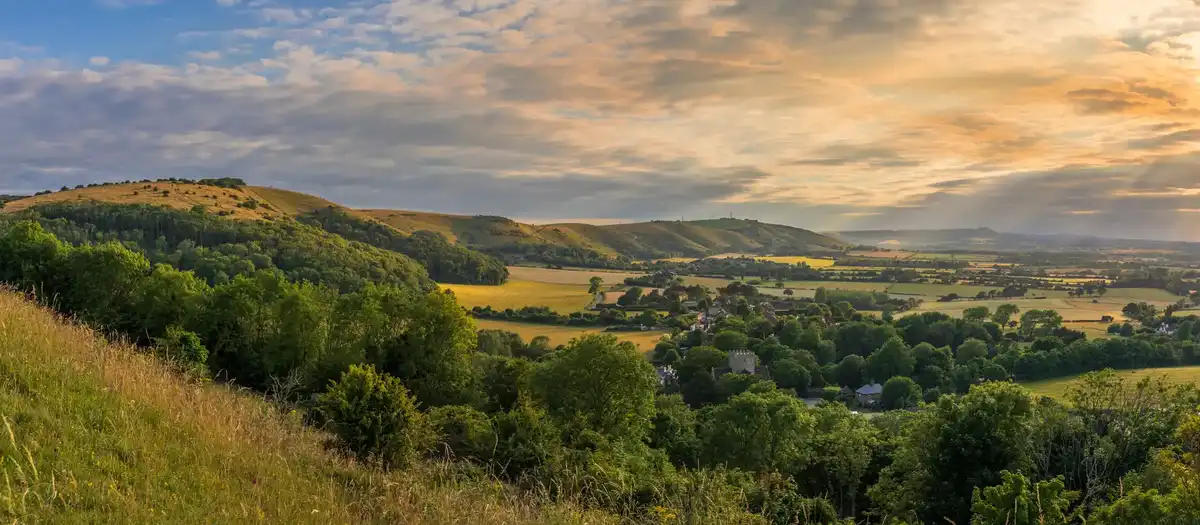
Exploring South East England
South East England brings together the counties of Kent, East Sussex, West Sussex, Surrey, Hampshire, Berkshire, Oxfordshire, Buckinghamshire and the Isle of Wight. Its landscapes range from the chalk hills of the North and South Downs to ancient woodlands, river valleys, open farmland and the coastlines of the English Channel and Thames Estuary. Historic towns, villages and coastal settlements provide places to explore across a region shaped by centuries of travel, trade and settlement.
Protected landscapes preserve some of the region's most distinctive environments. The South Downs National Park extends across Hampshire, West Sussex and East Sussex, encompassing chalk downland, wooded valleys and the coastal cliffs around the Seven Sisters. The Kent Downs National Landscape follows the chalk hills and countryside of Kent, while the Surrey Hills National Landscape protects wooded hills, heathland and villages south of London. Further north and west, the Chilterns National Landscape extends into Buckinghamshire and Oxfordshire, with beech woodlands, chalk escarpments and historic routes through the countryside. The High Weald National Landscape stretches across parts of Kent, Sussex and Surrey, characterised by wooded ridges, small fields, historic villages and deeply incised valleys.
Long-distance trails connect many of these landscapes. The South Downs Way follows the chalk ridge from Winchester to Eastbourne, crossing open downland and the South Downs National Park. The North Downs Way runs from Farnham towards Dover, with a branch to Canterbury, following chalk hills and historic routes through Surrey and Kent. The 1066 Country Walk connects Pevensey and Rye through the historic countryside of East Sussex, while the Pilgrims' Way follows an ancient corridor between Winchester and Canterbury.
Other established routes explore the region's rivers, woodlands and coastal landscapes. The Thames Path follows the River Thames through Oxfordshire, Berkshire and Buckinghamshire before continuing through Greater London to the Thames Barrier. The Ridgeway crosses the chalk countryside of Oxfordshire and Buckinghamshire, while the Vanguard Way connects the outskirts of London with the Sussex coast. Around the Isle of Wight, the Isle of Wight Coastal Path follows cliffs, beaches, estuaries and coastal settlements around the island.
Beyond the long-distance trails, South East England offers opportunities to explore historic towns, villages, nature reserves, coastlines and wild places on foot. From the chalk cliffs of the Seven Sisters and the woodlands of the High Weald to the Thames Valley, the Surrey Hills and the beaches of Kent and Sussex, the region provides a varied setting for shorter walks, walking breaks and multi-day journeys, with places to stay across its towns, villages and countryside.