
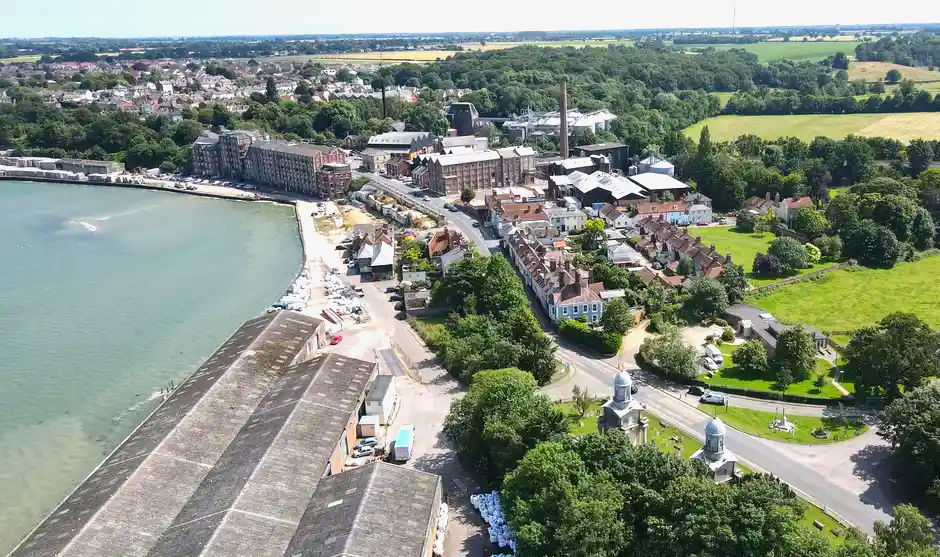
Georgian architecture, historic quays and the Stour Estuary
Mistley is a historic village in north-east Essex, situated on the southern shore of the Stour Estuary between Manningtree and the countryside towards Wrabness. Known for its Georgian architecture, historic quays and distinctive church towers, the village has a long association with maritime trade and the development of the River Stour as an important commercial waterway. Its waterfront setting provides views across tidal waters towards Suffolk, while local paths connect the village with neighbouring settlements and the wider estuary landscape.
Mistley's development was closely associated with Richard Rigby, an eighteenth-century politician and landowner who sought to transform the village into a fashionable spa resort. Although the ambitious plans were never fully realised, they left a lasting architectural legacy, including the village's distinctive Georgian buildings and the surviving Mistley Towers. The towers, designed by the architect Robert Adam, are among the most recognisable landmarks on this part of the Essex coast.
Standing near the centre of the village, Mistley Towers are the surviving elements of the former Church of St Mary the Virgin. Their elegant classical design reflects the aspirations of Mistley's eighteenth-century redevelopment and provides a striking contrast with the traditional buildings and working waterfront nearby. The towers remain an important historic landmark and offer an insight into a period when Mistley was being reshaped as a planned Georgian settlement.
Along the waterfront, Mistley's historic quays recall the village's role in shipping, milling and the movement of agricultural goods. The River Stour provided a commercial connection between inland farms, local industries and coastal trading routes, supporting warehouses, wharves and other waterfront buildings. Today, the surviving industrial and maritime features contribute to the village's distinctive character, while boats and tidal channels reflect its continuing relationship with the estuary.
The Stour Estuary is one of the area's most important natural landscapes, with extensive mudflats, saltmarsh and shallow tidal waters supporting a variety of birdlife. At low tide, exposed mud attracts waders and wildfowl, while the changing light and water levels create broad views towards the Suffolk shore. Walking along the waterfront offers opportunities to observe the estuary's wildlife and experience the open coastal landscape.
The Essex Way, a long-distance walking route between Epping and Harwich, passes through Mistley and provides connections along the southern side of the estuary. Westwards, the route leads towards Manningtree, where historic streets, independent shops and railway connections make the town an accessible starting point for exploring the area. Eastwards, the path continues through the countryside towards Wrabness, passing farmland, woodland and sections of the estuary shoreline.
Further east, Wrabness Nature Reserve provides opportunities to explore coastal woodland, grassland and saltmarsh overlooking the River Stour. The reserve is particularly rewarding for birdwatching and quieter countryside walks, while nearby A House for Essex has become a distinctive architectural landmark within the surrounding landscape. Beyond Wrabness, the estuary continues towards Harwich, where the River Stour meets the River Orwell and the North Sea.
Mistley also offers access to the inland landscapes of the Stour Valley. From neighbouring Manningtree, visitors can connect with the St Edmund Way, which begins at Manningtree railway station and continues north through Suffolk towards Brandon. Nearby Cattawade marks the eastern end of the Stour Valley Path, providing opportunities to explore the river valley towards Dedham, Flatford and the countryside associated with John Constable.
For visitors staying in Mistley, The Mistley Thorn offers boutique guest rooms and restaurant dining in a historic building close to the waterfront. Its position in the village makes it convenient for exploring Mistley Towers, enjoying walks beside the Stour Estuary and following sections of the Essex Way. With Manningtree, Wrabness and the surrounding Essex countryside within easy reach, the hotel provides an attractive setting for a relaxed two- or three-night stay.
Featured Stay

The Mistley Thorn, Mistley
Stay at The Mistley Thorn in the Essex village of Mistley, a historic hotel and restaurant with individually styled guest rooms, seasonal dining and views towards the Stour estuary, close to Manningtree, riverside walks and the landscapes of Constable Country.
Check availability
Select your dates to check current availability and prices.