
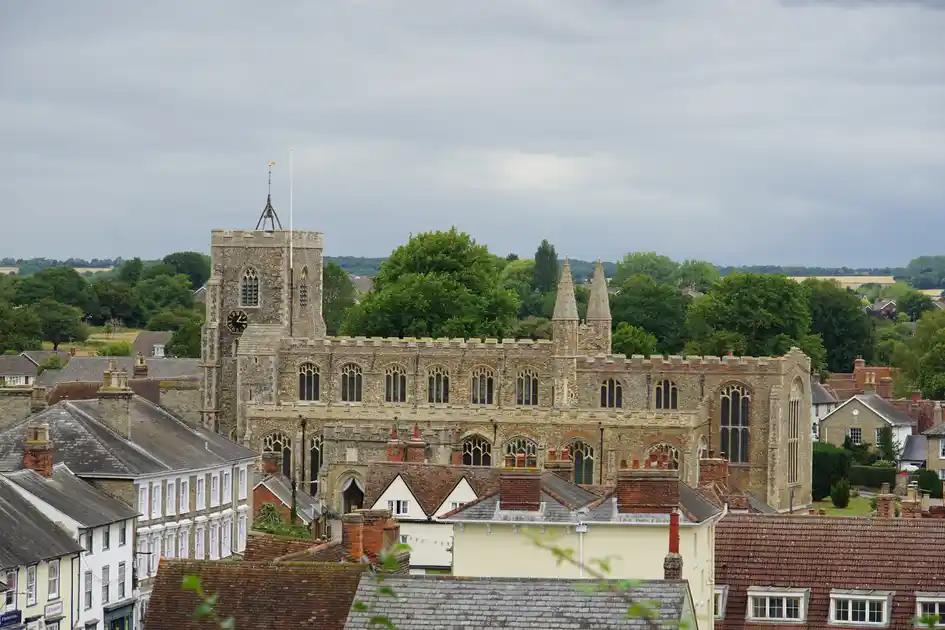
Medieval streets, castle ruins and the upper Stour Valley
Clare is a historic market town in western Suffolk, situated beside the River Stour in the gently rolling countryside of the Stour Valley. Known for its medieval buildings, historic wool-trade heritage and the remains of its Norman castle, Clare combines a distinctive town centre with riverside paths, open countryside and places to explore on foot. Its position along the Stour Valley Path makes it an appealing destination for discovering the landscapes and settlements of the upper valley.
Clare developed into an important medieval market town, with much of its prosperity connected to the wool and cloth trades. The historic centre retains timber-framed buildings, traditional shopfronts and narrow streets that reflect centuries of commercial and domestic life. Around the town, independent shops, cafés and traditional pubs occupy buildings of different periods, creating an attractive setting for exploring its architectural heritage at a relaxed pace.
One of Clare's principal landmarks is Clare Castle Country Park, where the remains of a Norman castle stand within landscaped grounds beside the river. The castle was once associated with the powerful de Clare family, whose influence extended across medieval England. Visitors can explore the surviving earthworks and castle remains, including the prominent motte, while paths through the park connect historic features with open green spaces, waterways and the former railway station.
The country park also preserves an important part of Clare's railway heritage. The former Clare railway station and its surviving buildings recall the period when the town was connected to the wider railway network. Today, the station forms part of the park's historic character, with walking routes following sections of the former railway landscape and providing access to the surrounding countryside.
Beyond the castle, Clare Priory is another important historic site, founded in the thirteenth century and associated with the Augustinian order. Its surviving medieval buildings and peaceful grounds reflect the town's religious history, while nearby St Peter and St Paul's Church stands as a prominent landmark within Clare's historic centre. Together, these sites reveal the importance of the town during the medieval period and its connections with the surrounding rural communities.
The River Stour flows through the southern part of Clare, providing opportunities for short riverside walks and connections with the surrounding countryside. Footpaths lead from the town into open farmland, meadows and quiet lanes, where the landscape gradually opens towards neighbouring villages. These routes offer a different perspective on Clare, moving from its compact historic streets into the agricultural countryside that has shaped the upper valley for centuries.
The Stour Valley Path passes through Clare on its journey between Newmarket and Cattawade, connecting the town with the wider river valley and its historic settlements. Walkers can follow sections of the route through the surrounding countryside, exploring villages, fields and riverside landscapes without committing to the full long-distance path. Clare's position makes it a useful stopping point for those following the route as well as visitors looking for shorter countryside walks.
Beyond Clare, the upper Stour Valley contains a network of historic villages, quiet lanes and traditional farmland. Nearby Cavendish is known for its village green and historic buildings, while Long Melford and Sudbury offer further opportunities to explore Suffolk's wool-trade heritage, riverside landscapes and countryside paths. Together, these destinations reveal the changing character of the valley as the River Stour flows east towards the Suffolk and Essex border.
Clare is particularly well suited to a relaxed day exploring its historic centre and surrounding countryside. Visitors can spend the morning discovering the castle ruins, priory and medieval streets, enjoy lunch in the town, and follow riverside or countryside paths during the afternoon. With independent shops, historic landmarks and access to the Stour Valley Path, Clare also provides an appealing setting for a longer visit to western Suffolk.
For visitors staying in Clare, Ship Stores Bed & Breakfast offers accommodation in a historic timber-framed building, within easy reach of the town's medieval streets and local attractions. Its location provides a convenient base for exploring Clare Castle Country Park, following sections of the Stour Valley Path and discovering neighbouring Cavendish and the countryside of the upper Stour Valley over a relaxed two- or three-night stay.
Featured Stay

Ship Stores Bed & Breakfast, Clare
Stay at Ship Stores Bed & Breakfast in the historic Suffolk town of Clare, with comfortable guest rooms in a timber-framed building, close to Clare Castle Country Park, the River Stour and countryside walks through the Stour Valley.
Check availability
Select your dates to check current availability and prices.


