
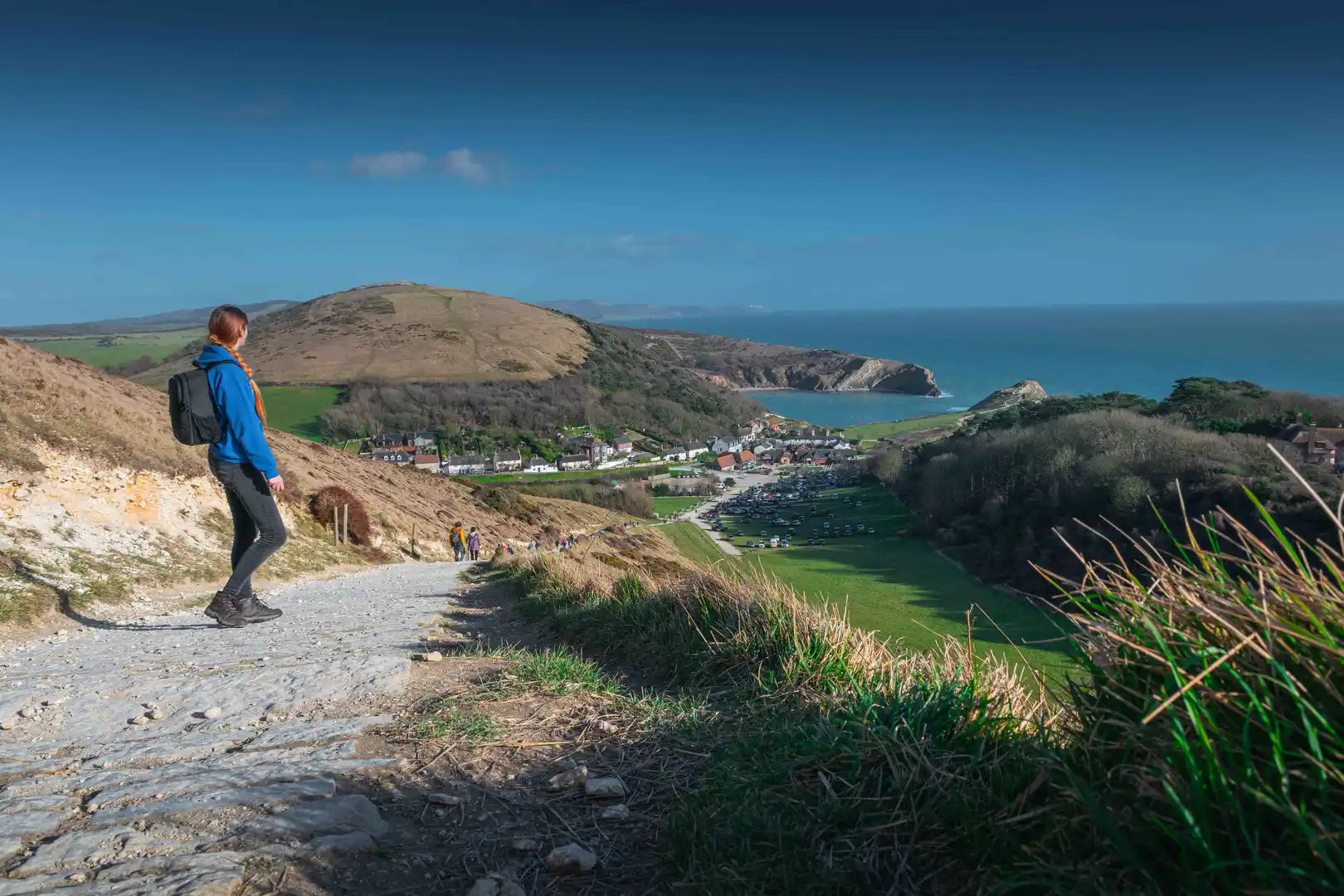

Girl in blue hoodie and with the black backpack looks on the Lulworth Cove, Jurassic Coast, Dorset, UK

South West Coast Path (Dorset & Jurassic Coast) – Walking Through Deep Time

Type of trail?
National Trail
Is it for me?
Challenging long-distance walk
Long days with sustained elevation change, repeated climbs and descents, and a demanding physical rhythm.
What will I see?
Surf beaches and rocky coves
Historic harbours and coastal towns
Panoramic Viewpoints
Seaside Towns & Fishing Harbours
Rural Villages
Open farmland
What’s the vibe?
Coastal heritage and culture
Countryside and coast
Peaceful and refreshing
Remote and Wild
Scenic and photogenic

Fossil cliffs, sweeping beaches, and England’s Jurassic Coast

The Dorset section of the South West Coast Path runs from Exmouth to Poole Harbour, around 95 miles of dramatic cliffs, sweeping pebble beaches, and world-famous geology. This is the final stretch of England’s longest National Trail, and it offers one of the most scenic walking holidays and outdoor adventures in the country.

Here, the path follows the Jurassic Coast UNESCO World Heritage Site, where 185 million years of Earth’s history are revealed in fossil-rich cliffs and striking rock formations like Durdle Door and Old Harry Rocks. Walkers encounter everything from the vast sweep of Chesil Beach to picturesque harbours like Lyme Regis, Weymouth, and Swanage.

The terrain is varied — with steady climbs over chalk headlands, easy promenades along seaside towns, and dramatic cliff paths where the Dorset coast meets the English Channel. Whether you walk the full stretch or dip into day walks, this section combines natural wonder, seaside culture, and world-class coastal scenery.

Trail Overview

  • Type: National Trail (waymarked with the Acorn symbol)
  • Distance: 95 miles (152 km)
  • Start: Exmouth, Devon
  • End: Poole Harbour, Dorset
  • Time required: 7–10 days (for the section)
  • Terrain: Clifftop paths, pebble beaches, chalk downs, harbour towns
  • Difficulty: Moderate to challenging — steady climbs and long days
  • Accessibility: Easier walking around seaside resorts; some strenuous headland climbs

Explore the Route

Exmouth to Lyme Regis

The trail leaves Exmouth, crossing red sandstone cliffs into East Devon’s Jurassic Coast. Highlights include the fossil-rich cliffs near Sidmouth and Seaton, finishing in Lyme Regis, famous for fossil hunting and maritime charm.

Lyme Regis to Weymouth

This stretch takes in Golden Cap, the highest point on the south coast of England, with wide views across Lyme Bay. The route continues past the village of Abbotsbury before reaching Weymouth, a lively seaside town.

Weymouth to Lulworth Cove

A dramatic stretch of coast, with the vast sweep of Chesil Beach, the Isle of Portland, and the world-famous rock arch of Durdle Door near Lulworth Cove.

Lulworth to Swanage

Here, the path climbs over chalk cliffs and rolling downs, with highlights including Worbarrow Bay and St Aldhelm’s Head before reaching Swanage on the Isle of Purbeck.

Swanage to Poole Harbour

The final stage includes the iconic Old Harry Rocks before the path descends into Studland Bay and the finish at Poole Harbour — the official end of the 630-mile South West Coast Path.

Stay and Explore

  • Seaside towns: Lyme Regis, Weymouth, Swanage, Exmouth
  • Coastal villages: Abbotsbury, Beer, and West Bay
  • Nature escapes: Farm stays, cliff-top B&Bs, and rural retreats near Lulworth and Purbeck
  • Food & drink: Dorset crab, seafood shacks, coastal pubs, and cream teas
  • Activities: Fossil hunting, kayaking, boat trips, birdwatching at Chesil Beach and Poole Harbour

Adventure Highlights

  • Walking the Jurassic Coast UNESCO World Heritage Site
  • Fossil-rich cliffs at Lyme Regis and Charmouth
  • Golden Cap, the south coast’s highest cliff
  • The vast sweep of Chesil Beach
  • Durdle Door and Lulworth Cove
  • Chalk headlands and Old Harry Rocks
  • Finishing the 630-mile South West Coast Path at Poole Harbour

Frequently Asked Questions

Where does the Dorset section of the South West Coast Path go?

This section runs from Exmouth in Devon to Poole Harbour in Dorset, covering around 95 miles. It follows the Jurassic Coast World Heritage Site through East Devon and Dorset.

How long does it take to walk the Dorset section?

Most walkers take 7 to 10 days to complete the Dorset stretch, though it can be broken into shorter day walks between seaside towns.

Is the Dorset Coast Path difficult?

It is rated moderate to challenging. Some parts are easy promenades near resorts, while others involve steep climbs over chalk cliffs and long distances along Chesil Beach.

What is the best part of the South West Coast Path in Dorset?

Highlights include Golden Cap, Durdle Door, Chesil Beach, and Old Harry Rocks. Fossil hunting at Lyme Regis and Charmouth is also world-famous.

When is the best time to walk the Dorset Coast Path?

The best months are May to September for warm weather and ferry services. Spring offers wildflowers, summer brings swimming opportunities, and autumn has quieter trails and dramatic coastal light.