
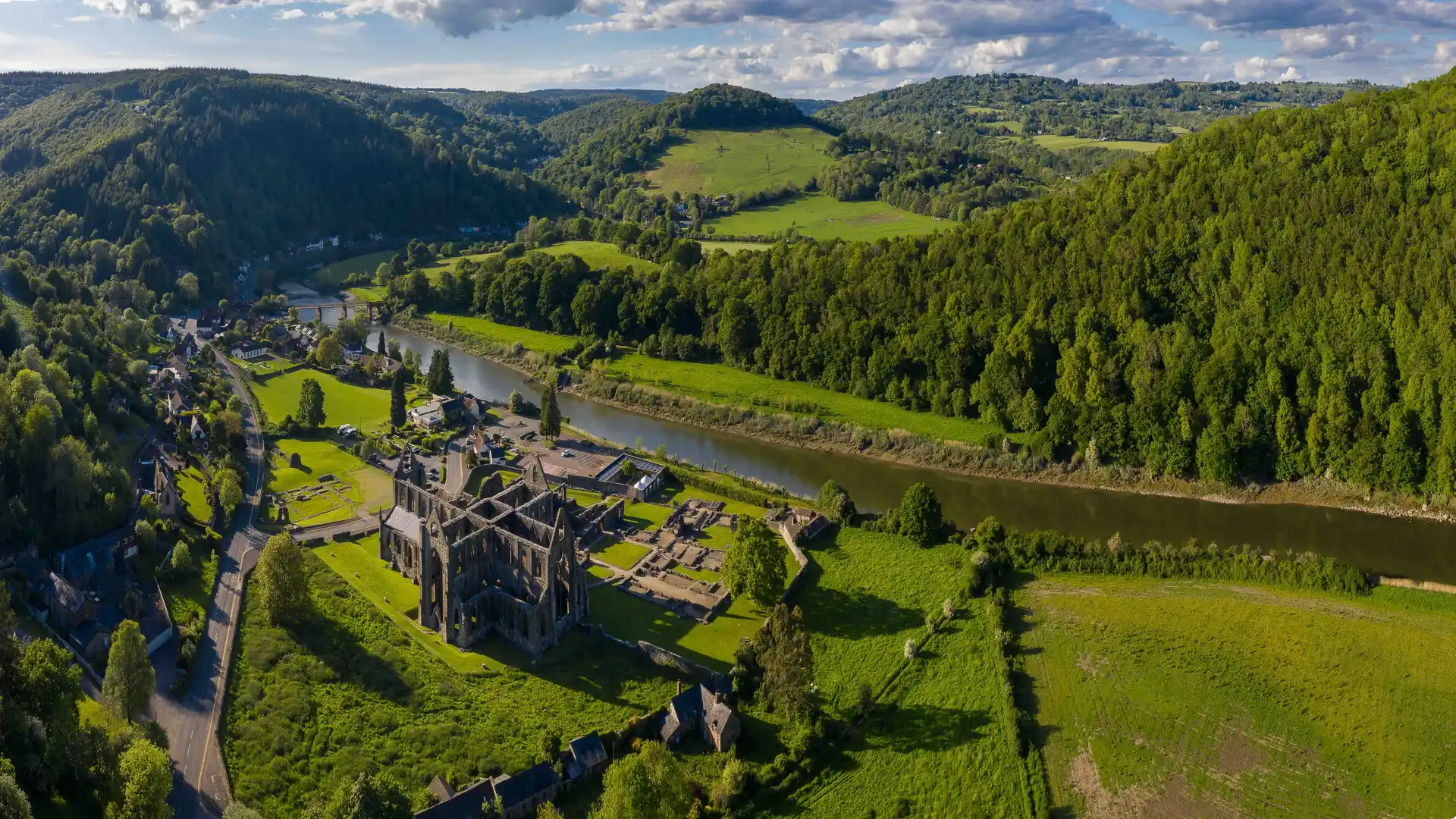
Meandering rivers, mixed woodland, and rolling hills shaped by water, farming, and long-settled routes
The Wye Valley and the surrounding Borders sit between England and Wales, where self-guided travel follows walking routes along the River Wye and across low ridges linking places such as Chepstow, Monmouth, Hay-on-Wye, and Hereford. Trails including the Offa’s Dyke Path and the Wye Valley Walk connect wooded slopes, open farmland, and historic market towns, creating steady movement between river, hill, and settlement across a compact border landscape.
The terrain is folded rather than steep. The River Wye curves through wooded gorges and broad meadows, while rounded hills and pasture rise gradually above the valley floor. Woodland is more continuous here than in much of southern Britain, and paths frequently pass through mixed forest before opening onto fields, orchards, and small villages.
Large sections of the valley fall within the Wye Valley National Landscape, protecting limestone cliffs, ancient woodland, and riverside habitats between Chepstow and Hereford. Elsewhere, farmland, hedgerows, and small estates shape a settled countryside where footpaths, bridleways, and quiet lanes link directly between towns and surrounding hills. Routes rarely feel remote, with settlement and farmland always close at hand.
Movement through the region tends to follow the course of the river or the line of the ridges. Valley paths provide level progress beside water, while higher routes track along hilltops before descending back to bridges, crossings, and town centres. Gradients are moderate, and distances between settlements are short, allowing routes to be combined easily into longer stages.
Stone bridges, church towers, and market squares appear regularly, marking natural points of arrival along the way.
Routes & Landscapes Across the Region
The Wye Valley Walk follows the river from Chepstow north through Monmouth and Hay-on-Wye to Hereford, tracing meadows, woodland, and riverside paths as it links many of the valley’s principal towns.
Running roughly parallel along higher ground, the Offa’s Dyke Path follows the historic border earthwork across ridges and farmland, providing longer upland sections with wide views across both Wales and England before descending again to the valley floor.
Shorter circular routes and connecting paths weave between the two, using quiet lanes, woodland tracks, and minor hills to create crossings between river and ridge without long detours.
Together, these riverside and hilltop routes form a connected network that allows movement along the valley or across it in varied stages.
Areas of the Wye Valley & Borders
The lower Wye around Chepstow and Tintern, the central valley between Monmouth and Ross-on-Wye, and the northern hills around Hay-on-Wye and Hereford each present distinct combinations of woodland, meadow, and ridge while remaining closely linked by the river corridor.
Beginning to explore the Wye Valley & The Borders
The Wye Valley and Borders function as a continuous river landscape rather than separate destinations. Following the water and the surrounding ridges gradually reveals how settlement, farming, and historic routes continue to shape movement across this long-established border region.