
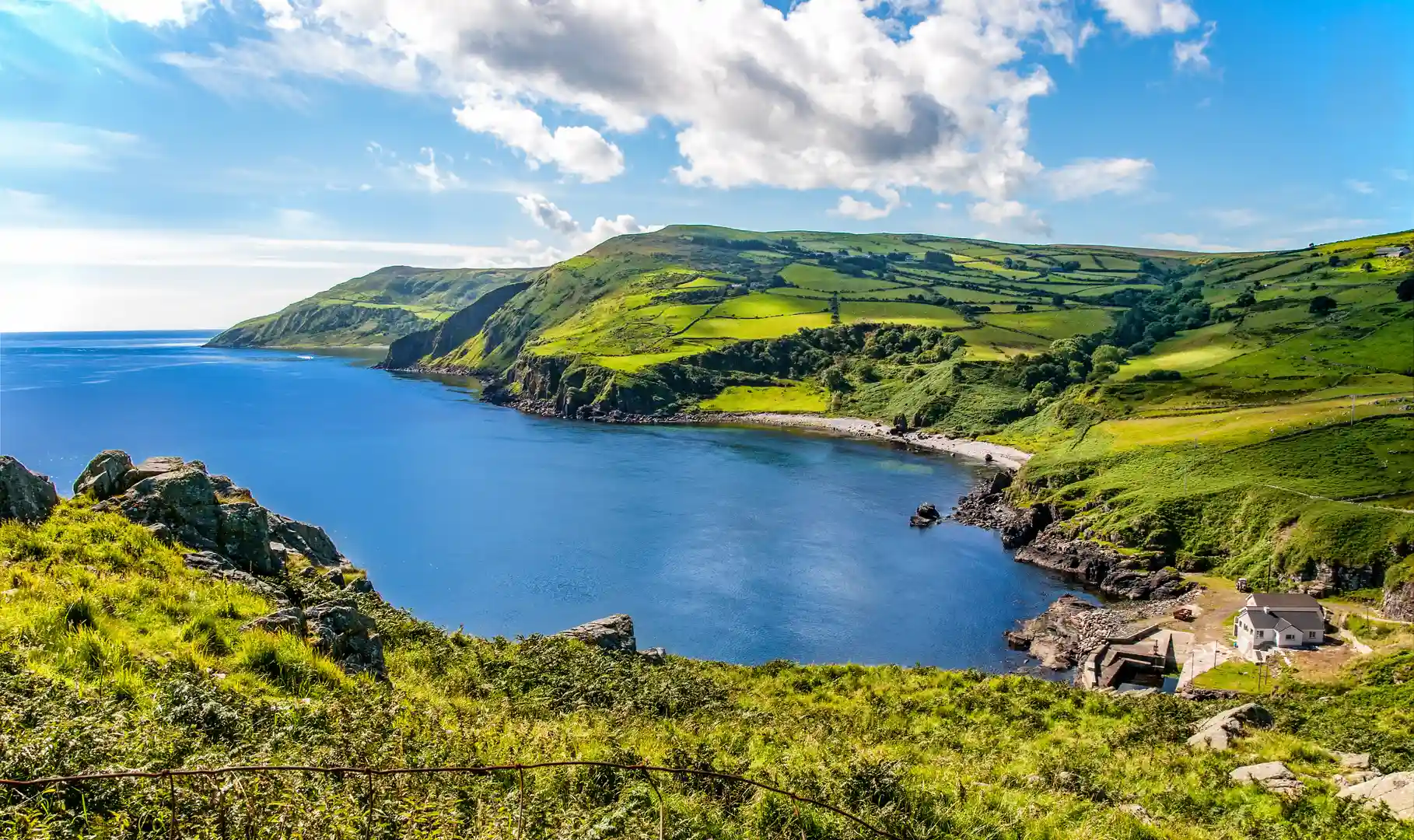
Volcanic coastline, deep glens, and open upland ground along Northern Ireland’s north-east.
County Antrim is a coastal county of basalt cliffs, glacial glens, and upland plateau in Northern Ireland. Walking routes cross the Giant’s Causeway UNESCO World Heritage Site and follow the Causeway Coast Way and sections of the Ulster Way, linking places such as Ballycastle, Cushendall, Cushendun, Larne, and Portrush across clifftop paths, valley tracks, and high open ground between the North Atlantic and Belfast Lough.
Much of the terrain is firm but varied underfoot. Clifftop paths, coastal tracks, forest roads, valley lanes, and open moorland allow steady progress, with regular short climbs and descents rather than sustained ascent. Surfaces range from grass and compact earth to gravel and rocky ground near cliffs.
The landscape shifts between areas. The north coast around Ballycastle and the Causeway Coast is defined by steep cliffs and headlands, while the Glens of Antrim cut inland as narrow wooded valleys. Away from the coast, the Antrim Plateau opens into broader upland pasture and moorland with fewer settlements.
Towns and villages are concentrated along the coast and at glen mouths, creating natural access points for shorter walks and longer linear routes, with more remote conditions across the plateau interior.
Trails and Routes Through County Antrim
Causeway Coast Way
Linear coastal route between Ballycastle and Portstewart following cliffs, beaches, and headlands past the Giant’s Causeway and Carrick-a-Rede.
Ulster Way (Antrim sections)
Long-distance regional route using coastal paths, minor roads, forest tracks, and upland sections through the Glens of Antrim.
Glenariff and Glenballyeamon Paths
Valley and woodland walking through river corridors and steep-sided glens.
Antrim Plateau Routes
Open upland walking on tracks and minor roads across high rolling ground.
Walking Character
- Basalt cliffs and volcanic headlands
- Narrow wooded glens
- Open upland plateau
- Coastal and clifftop paths
- Short, frequent climbs
- Settlements focused on coast and valley mouths
- Exposed coastal and high ground sections
Check availability
Select your dates to check current availability and prices.