
Clifftop paths, exposed headlands, and working harbours shaped by sea, rock, and tide
The Causeway Coast runs along Northern Ireland’s north coast between Lough Foyle and Ballycastle, where self-guided travel follows walking routes along cliffs, beaches, and narrow coastal lanes linking places such as Portstewart, Portrush, Bushmills, Ballintoy, and Ballycastle. Paths including the Causeway Coast Way connect headlands, coves, and small harbours in a largely continuous line shaped by the Atlantic and the underlying basalt rock.
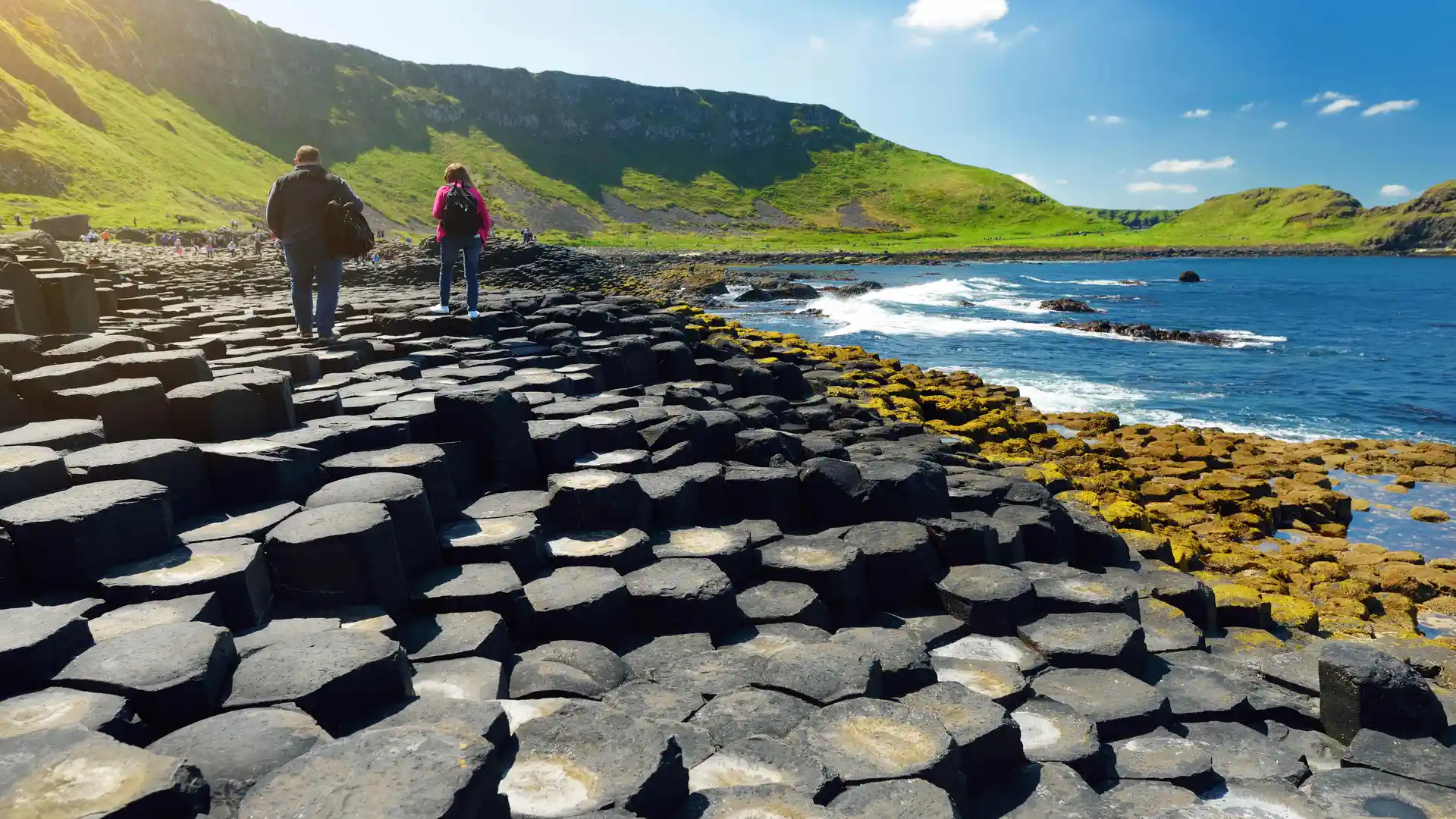
The coastline is direct and exposed. Cliffs rise sharply from the sea, broken by rocky bays, beaches, and short river mouths. Basalt columns, offshore stacks, and stepped headlands give the shore a distinctive, angular form, while inland ground lifts quickly into rough pasture and open moor. Elevation changes are frequent but short, with repeated climbs and descents between each inlet.
Much of the coast sits within the Causeway Coast National Landscape protecting cliffs, grassland, and coastal habitats between settlements. The Giant’s Causeway and surrounding headlands form part of a UNESCO World Heritage Site, while farmland and small villages continue directly up to the edge of the path. Routes pass easily between open shoreline and inhabited places without long gaps between services.
Movement along the Causeway Coast is predominantly linear. Trails follow the edge of land and water, linking one headland to the next before dropping to beaches or harbours and climbing again. Distances between towns are relatively short, creating a steady sequence of stages rather than extended remote sections.
Harbours, lighthouses, and village streets appear at regular intervals along the route, marking natural transition points along the shoreline.
Routes & Landscapes Across the Region
The Causeway Coast Way follows the shoreline from Portstewart through Portrush, past Dunluce Castle and the Giant’s Causeway to Ballintoy and Ballycastle, combining clifftop paths, beaches, and quiet roads in a continuous coastal route.
Around the Giant’s Causeway and Benbane Head, steeper ground and higher cliffs create more sustained ascents and descents, while stretches near Portstewart Strand and White Park Bay open into longer sandy sections with level walking beside the sea.
Short inland links and minor roads connect coastal sections with Bushmills and nearby villages, allowing routes to be adjusted into shorter stages or circular walks.
Together, these cliff, beach, and headland paths form a clear linear corridor along the north coast.
Areas of the Causeway Coast
Portstewart and Portrush on the western side, the Giant’s Causeway and Bushmills area at the centre, and the eastern cliffs and bays around Ballintoy and Ballycastle each present distinct combinations of beach, headland, and harbour within a relatively compact stretch of coastline.
Beginning to explore the Causeway Coast
The Causeway Coast functions as a single continuous shoreline. Following its clifftop and beach paths shows how geology, tide, and settlement shape movement along the outer edge of Northern Ireland.