
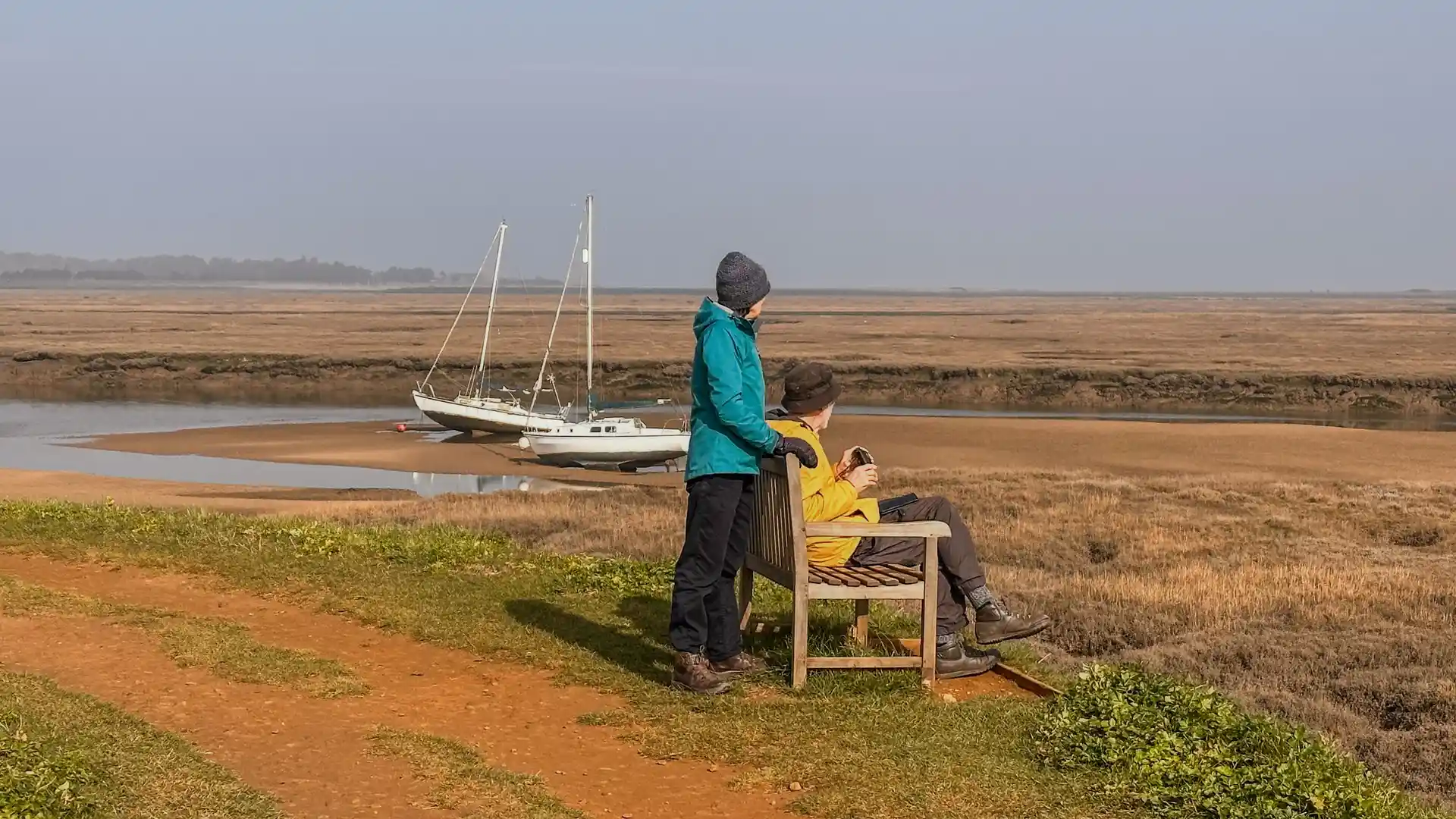
Some walks are about distance or difficulty.
Walking the Norfolk Coast Path is about space — wide beaches, tidal skies, and the slow rhythm of a shoreline shaped by wind, water, and light.
Running from Hunstanton to Hopton-on-Sea, this National Trail traces the full sweep of the Norfolk coast. It’s one of England’s most relaxed long-distance routes, offering a walking holiday that feels expansive and restorative rather than demanding, with scenery that changes subtly from day to day.
A Coast Shaped by Water and Light
The Norfolk Coast Path follows a landscape defined by movement. Tides reshape creeks and saltmarsh, dunes shift with the wind, and light transforms the coast hour by hour. The walking itself is straightforward, but the environment is anything but static.
From the start beneath Hunstanton’s striped cliffs, the trail moves through open coastal country — beaches, grassy banks, and low dunes — where the horizon always feels close. Inland, pinewoods and quiet lanes provide contrast before the route returns again and again to open shoreline.
This constant variation is what gives the path its depth. Each day feels distinct, even though the walking remains gentle and well paced.
Villages, Harbours, and Coastal Life
What makes the Norfolk Coast Path especially rewarding as a walking holiday is the way it links places that still feel rooted in everyday coastal life. Fishing harbours, village greens, and traditional seaside towns appear at regular intervals, shaping the journey without interrupting its flow.
Places such as Wells-next-the-Sea, Blakeney, Cley-next-the-Sea, and Cromer offer natural stopping points, each with its own character. Quieter stretches between Mundesley, Sea Palling, and Winterton-on-Sea bring a slower, more reflective pace, where long beaches and open skies dominate.
These settlements are not staged attractions — they’re working coastal communities, and that authenticity is a large part of the trail’s appeal.
Easy Walking, Rich Rewards
The Norfolk Coast Path places very few physical demands on the walker. The terrain is mostly flat, paths are clearly marked, and daily distances are manageable, making it an ideal choice for a self-guided journey, particularly for those new to long-distance routes.
Days tend to unfold naturally: walking beside the sea in the morning, stopping for lunch in a village or harbour, and arriving at your next overnight stop with time to enjoy the coast. With accommodation arranged in advance, the focus stays firmly on the experience rather than on logistics.
From Inland Routes to Open Shoreline
At Holme-next-the-Sea, the Norfolk Coast Path connects directly with the Peddars Way, creating one of England’s most satisfying inland-to-coast walking combinations. Together, the two trails offer a journey that moves from Roman road and heathland to open beaches and saltmarsh — a natural progression that feels both coherent and complete.
For many walkers, this pairing transforms a coastal walk into a longer, more immersive walking holiday without increasing technical difficulty.
Why the Norfolk Coast Path Works as a Walking Holiday
The appeal of the Norfolk Coast Path lies in its balance. It’s long enough to feel like a genuine journey, gentle enough to be enjoyed at an unhurried pace, and varied enough to remain engaging throughout.
For walkers looking for relaxed coastal walking, that combines nature, villages, and big skies without physical strain — it’s one of the most rewarding routes in England.
Explore the Norfolk Coast Path
Explore the full trail guide and walking options for the Norfolk Coast Path →