
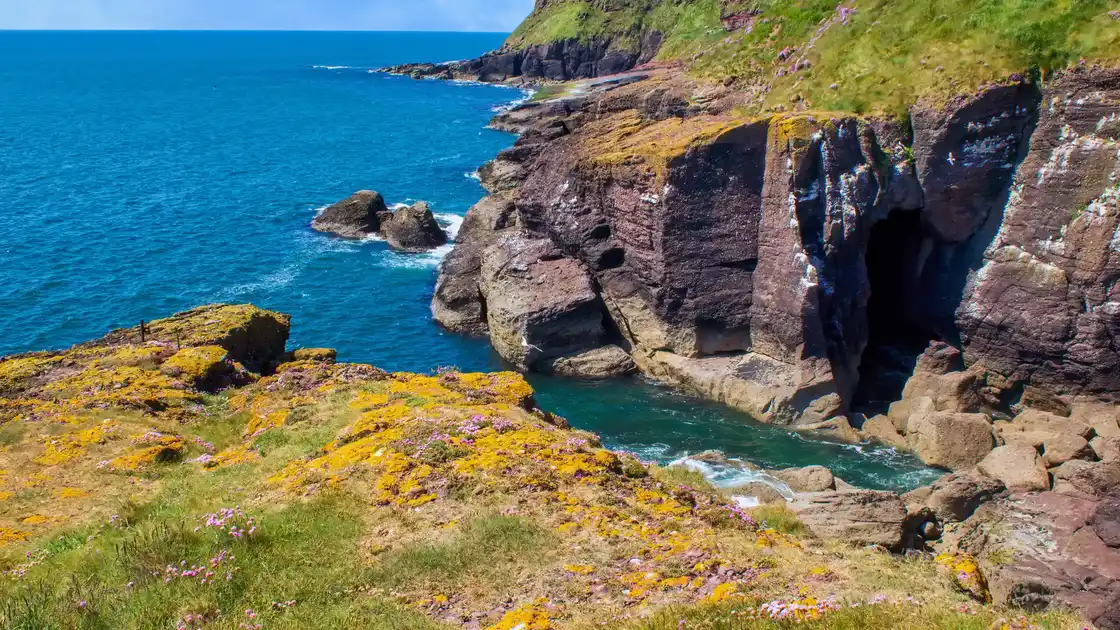
Explore the Copper Coast UNESCO Global Geopark
The Copper Coast UNESCO Global Geopark lies along the coast of County Waterford in south-east Ireland, between Tramore and Dungarvan. Extending from Fenor in the east to Stradbally in the west and inland towards Dunhill, the Geopark protects a landscape of cliffs, coves, beaches, rocky headlands and countryside shaped by hundreds of millions of years of geological change.
The rocks of the Copper Coast record a geological history stretching back around 460 million years. Ancient volcanic activity created many of the rocks visible along the coastline today, while later periods of mountain building, erosion and glaciation continued to shape the landscape.
This geological history can be seen particularly clearly along the coast. Cliffs and rocky shores expose layers of volcanic and sedimentary rock, while small coves, beaches and headlands reveal different stages in the development of the landscape.
The area's geology also influenced its human history. Copper mining became an important part of life along the coast, particularly around Bunmahon and Knockmahon, and traces of this industrial heritage remain visible within the landscape.
Bunmahon lies at the heart of the Geopark and is home to the Copper Coast Geopark Visitor Centre. From here, the surrounding coastline can be explored through a network of geosites that reveal different aspects of the area's geological, natural and cultural heritage.
Along the coast, places including Kilfarrasy Strand, Kilmurrin Cove, Bunmahon Head, Stradbally Cove and Dunabrattin Head reveal a succession of beaches, cliffs, rock formations and coastal landscapes. Inland sites add archaeological, ecological and mining heritage to the story of the Geopark.
Walking is one of the best ways to explore individual parts of the Copper Coast. Rather than following a single continuous long-distance trail, visitors can use coastal villages and nearby towns as bases for shorter walks around beaches, headlands, geosites and historic landscapes.
Bunmahon, Annestown, Stradbally and the wider coast between Tramore and Dungarvan provide useful bases for exploring the area. Staying for several nights allows different parts of the Geopark to be discovered independently, combining coastal walks with beaches, geological sites and the historic landscapes of County Waterford.
Overview
Designation: UNESCO Global Geopark
UNESCO designation: 2015
Location: County Waterford, Ireland
Area: Fenor to Stradbally, extending inland towards Dunhill
Landscape: Sea cliffs, coves, beaches, rocky headlands, farmland and coastal countryside
Known for: Geological heritage, ancient volcanic rocks, copper mining heritage, coastal scenery and geosites
Check availability
Select your dates to check current availability and prices.