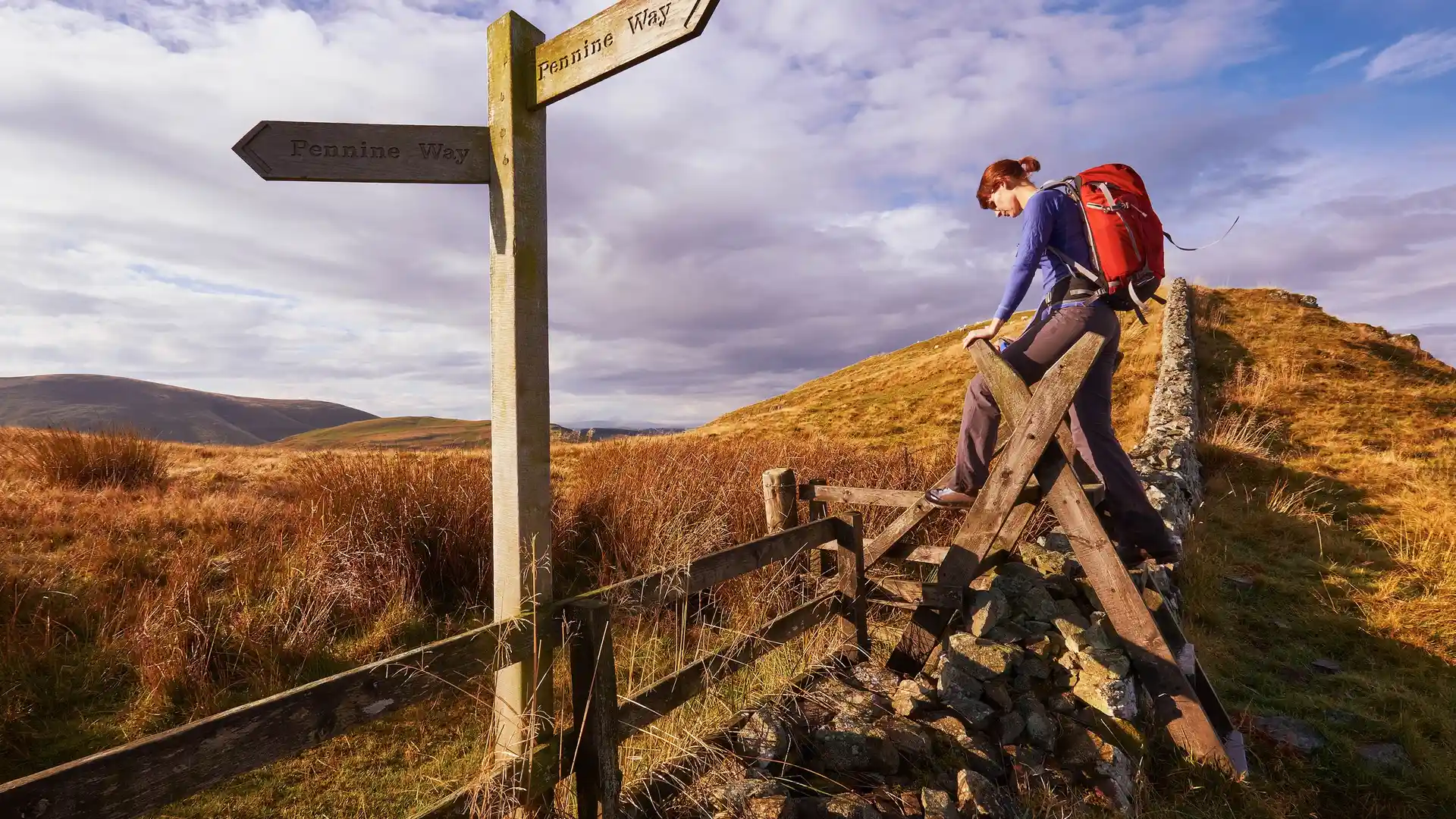
A female hiker climbs over a stone wall along the Pennine Way.
Home
>
England
>
The Midlands
>
Derbyshire
>
Pennine Way

Pennine Way – Walking Holidays & Outdoor Adventures

Type of trail?
National Trail
Is it for me?
Epic & demanding
Multi-day or high-altitude; for experienced walkers only.
What will I see?
Rolling Countryside
Heathland Trails
Historic & Heritage Sites
Scenic Hills
Lakes & Rivers
Wild Moorland
Mountain Landscapes
Open Farmland
Pine Forests
Rural Villages
Woodland Trails
What’s the vibe?
Adventurous & Challenging
Historic & Cultural
Peaceful & Relaxed
Remote & Wild
Scenic & Photogenic

England’s most iconic long-distance trail across the spine of the country

The Pennine Way is England’s original long-distance footpath — a 268-mile (431 km) National Trail from Edale in the Peak District to Kirk Yetholm in the Scottish Borders. It crosses some of Britain’s most dramatic upland landscapes: the Dark Peak moors, the limestone country of the Yorkshire Dales, the open ridges of the North Pennines, the rolling hills of Northumberland National Park, and finally the wild Cheviots.

This is a journey through England’s outdoor heritage — peat bogs, gritstone plateaus, ancient packhorse routes, river gorges, stone villages, and remote upland ridges. Each section brings its own personality: the atmospheric heights of Kinder Scout, the sculpted limestone of Malham Cove, the waterfalls of Teesdale, and the sweeping solitude of the Cheviot Hills.

The Pennine Way can be walked in full or experienced in shorter stages thanks to excellent rail access in the Peak District and Yorkshire Dales.

Trail Overview

Type: National Trail (Long-Distance)
Distance: 268 miles (431 km)
Start/End: Edale (Derbyshire) – Kirk Yetholm (Scottish Borders)
Time Required: 14–20 days
Terrain: Moorland plateaus, upland ridges, limestone dales, valley paths, farmland, forest trails
Difficulty: Hard — long stages, changeable weather, navigation required
Accessibility: Rail access at Edale, Hebden Bridge, Gargrave, Horton-in-Ribblesdale; buses throughout the Dales and North Pennines

Explore the Route

Edale to Kinder Scout – The Dark Peak

Begin your journey in the classic moorland valley of Edale, climbing Jacob’s Ladder onto the Kinder Scout plateau. This opening section delivers gritstone edges, peat bogs, sweeping views, and the famous Kinder Downfall.

Kinder to Standedge – Moorland Crossings

Follow exposed moorland tracks over Bleaklow and Black Hill, with panoramic views across the Peak District and into Yorkshire.

Yorkshire Dales – Limestone Country & Hilltop Summits

One of the trail’s most varied stretches: dramatic scenery at Malham Cove, the climb up Fountains Fell, the iconic ascent of Pen-y-ghent, and the long, scenic crossing of Great Shunner Fell into Swaledale.

Swaledale to Teesdale – Meadows & Waterfalls

Walk through classic Dales villages such as Thwaite, Muker, and Keld, then enter Teesdale along river valleys leading to High Force and Cauldron Snout.

North Pennines – Wide Horizons & Quiet Trails

A remote, atmospheric section with long upland crossings and dramatic open spaces.

Northumberland National Park – Wild Ridges & Open Sky

The trail follows high-level ridgelines into one of England’s wildest landscapes, passing through Bellingham and rolling into the Cheviot Hills.

Cheviot Hills to Kirk Yetholm – A Classic Finish

A superb finale over quiet, grassy ridges with far-reaching views. The final descent into Kirk Yetholm marks the end of one of Britain’s greatest walking journeys.

Stay and Explore

Towns & Villages Along the Route

Edale • Hebden Bridge • Haworth (nearby) • Malham • Horton-in-Ribblesdale • Hawes • Keld • Middleton-in-Teesdale • Bellingham • Byrness • Kirk Yetholm

Accommodation

Traditional inns, walkers’ hostels, B&Bs, bunk barns, farm stays, and small hotels. Many locations cater specifically to long-distance walkers with:

Food & Drink

Country pubs, village cafés, Dales tearooms, bakeries, and classic upland inns. Popular stops include pubs in Edale, Malham, Hawes, Muker, and Bellingham.

Culture & Landscape

Kinder Scout mass trespass history • Limestone formations • Classic stone-built Dales villages • Teesdale waterfalls • Remote Cheviot ridges • Historic market towns

Adventure Highlights

Frequently Asked Questions

How difficult is the Pennine Way?

It’s considered one of Britain’s toughest long-distance trails, with long days and exposed terrain. Good fitness and navigation are essential.

When is the best time to walk it?

May to September offers the best weather, with long daylight hours. Spring and early autumn can be less crowded.

Do I need to book accommodation in advance?

Yes — especially in summer, as small villages have limited capacity.

Can I walk shorter sections instead of the whole route?

Absolutely. Many walkers tackle the Pennine Way in stages, using public transport to connect start and finish points.

Is it well signposted?

Yes. It’s a National Trail marked with the acorn symbol, but sections across open moorland may require a map, compass, or GPS navigation.