
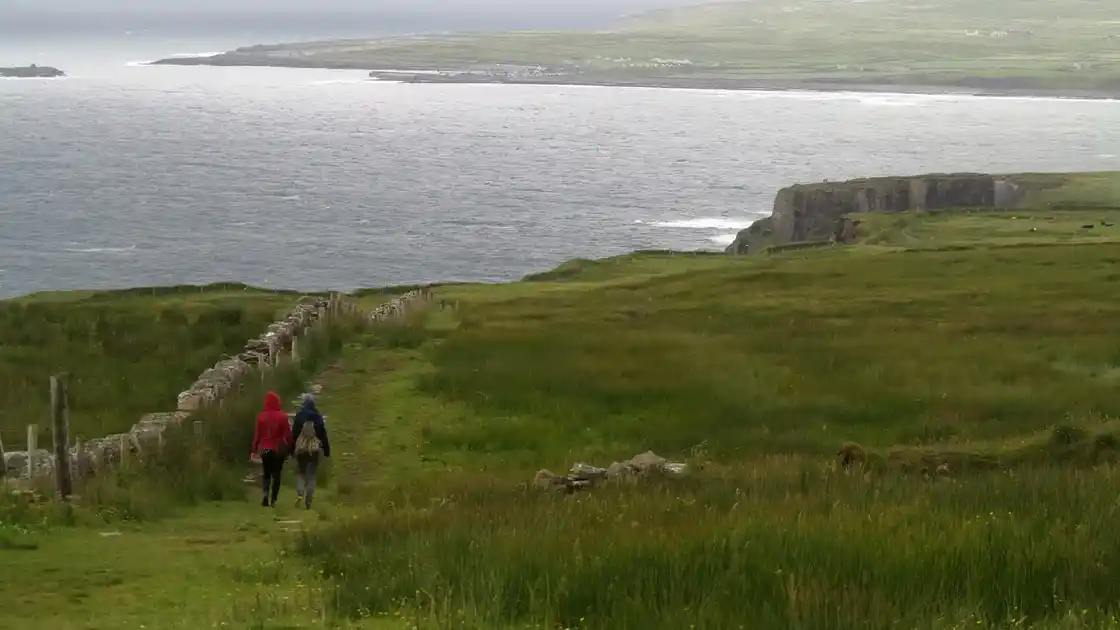
Walk the Burren Way
The Burren Way is a 74-mile long-distance walking route from Lahinch to Corofin in County Clare. Beginning close to the Atlantic coast, the trail travels through the distinctive limestone landscapes of the Burren before finishing on its south-eastern edge.
From Lahinch, the Burren Way heads north through coastal countryside towards the Cliffs of Moher and Doolin. Atlantic views and the exposed landscapes of the western Clare coast characterise the opening part of the route.
Around Doolin, the trail begins its journey inland through the northern Burren. The route continues towards Lisdoonvarna, with limestone hills, stone walls and open countryside replacing the coastal landscapes of the earlier stages.
Beyond Lisdoonvarna, the Burren Way crosses increasingly distinctive limestone country. Old roads and tracks lead through a landscape of exposed rock, enclosed fields and scattered farms beneath the hills of the Burren.
The route continues towards Ballyvaughan on the southern shore of Galway Bay. The village provides one of the principal bases along the northern part of the trail and a useful starting point for exploring the surrounding limestone landscape.
From Ballyvaughan, the Burren Way turns south into the heart of the Burren. Quiet roads, green roads and old tracks lead through sparsely settled countryside towards Carran.
Around Carran, limestone pavement, low hills, stone walls and farmland create some of the most characteristic landscapes of the route. The trail continues south through the eastern Burren towards the lower countryside around Corofin.
The Burren Way finishes at Corofin, on the south-eastern edge of the Burren. From the Atlantic coast at Lahinch to the limestone interior, the route provides a varied journey through one of Ireland's most distinctive landscapes.
Lahinch, Doolin, Lisdoonvarna, Ballyvaughan, Carran and Corofin provide useful bases along the route. Although the complete Burren Way is a multi-day walk, its succession of villages and contrasting coastal and limestone landscapes also makes it well suited to shorter sections and stay-based walking breaks around the Burren.
Overview
Distance: 74 miles / 119 km
Typical duration: 5 walking days
Difficulty: Moderate
Start: Lahinch, County Clare
Finish: Corofin, County Clare
Terrain: Green roads, minor roads, old tracks, limestone paths, grassy and rocky tracks and sections of public road
Check availability
Select your dates to check current availability and prices.