
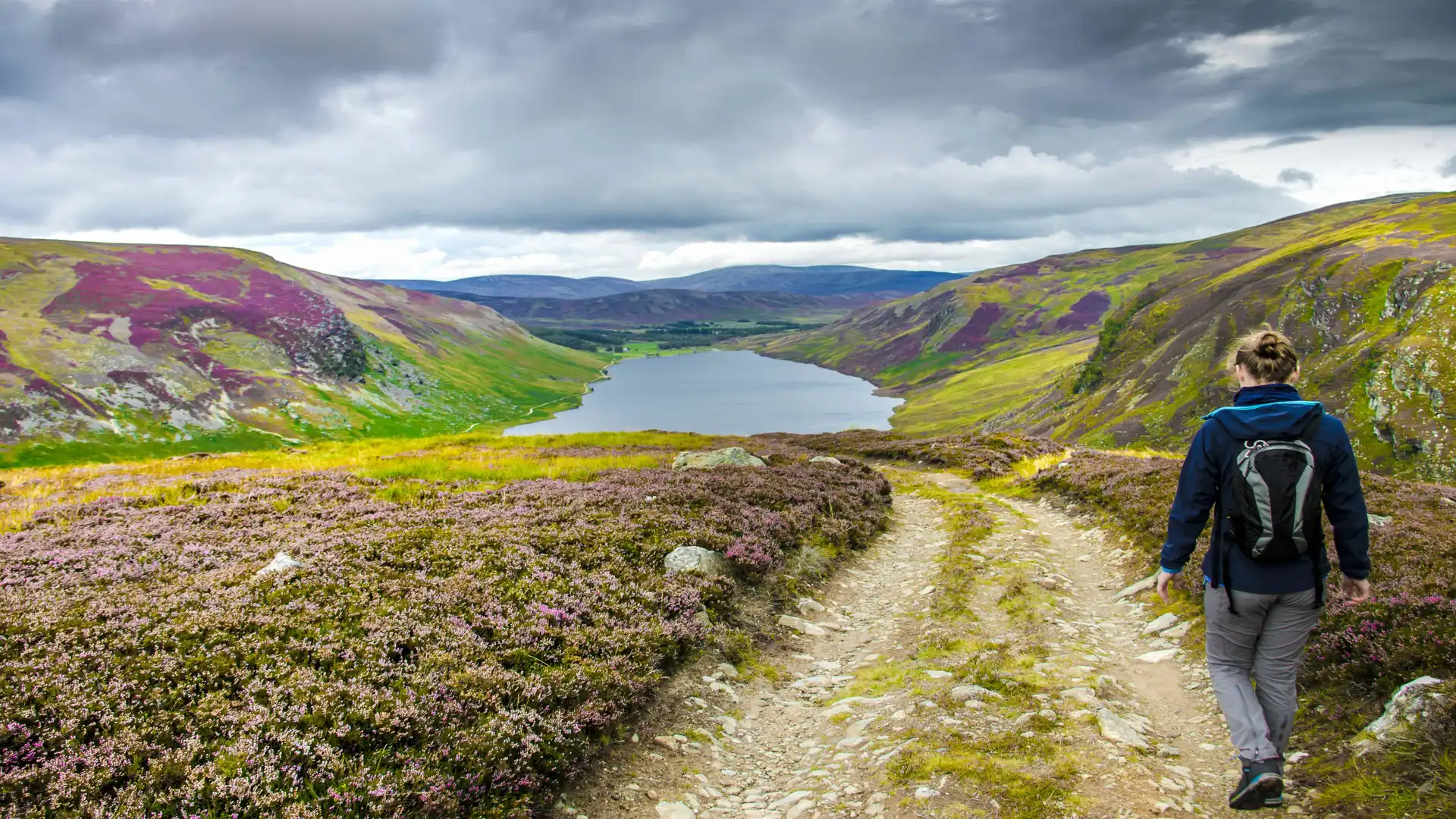
Clifftop shores, river valleys, and pine forests shaped by sea, stone, and long Highland light
Wide beaches, pine forests, and long river valleys shape North East Scotland, where coastal paths along the Moray Firth and inland trails through Cairngorms National Park follow the Rivers Dee and Spey between towns including Aberdeen, Stonehaven, Ballater, and Aviemore, creating a landscape that flows naturally from sea cliffs to woodland, farmland, and mountain.
This is a meeting point between coast and Highlands. To the east, long beaches, fishing harbours, and low sandstone cliffs face the North Sea. Inland, pine forest and heather moor rise gradually towards the Grampian Mountains, while broad river valleys carve green corridors through otherwise open ground. Walking here often shifts quickly between environments, from shoreline to forest to upland within a single day.
Much of the region’s character is shaped by protection and tradition. Large parts of Deeside and Speyside fall within Cairngorms National Park, where native Caledonian pinewoods, high plateaus, and wildlife-rich glens create some of Scotland’s most accessible upland terrain. Along the coast, dunes, estuaries, and headlands provide important habitats for birds and marine life, while old fishing villages and harbour towns anchor the shoreline.
Routes frequently follow historic lines. Estate tracks, old drove roads, railway paths, and riverside trails guide walkers through glens and woodland, linking settlements that have long depended on farming, fishing, and whisky distilling. The Speyside Way traces the River Spey between mountains and sea, while Deeside paths follow the River Dee towards Balmoral and the eastern Cairngorms. These natural corridors make longer journeys feel continuous and well connected.
Progress is generally moderate and steady. Gradients build gradually rather than abruptly, surfaces are varied but manageable, and towns appear regularly, offering natural breaks between stretches of forest, field, or coast. The atmosphere feels open and bright, shaped by big skies, sea air, and long northern light.
This is a region best understood step by step: along clifftops above the North Sea, through pine forest and river valley, and into the foothills of the Highlands.
Routes & Landscapes Across the Region
The Speyside Way follows the River Spey between the Cairngorms National Park and the Moray coast, combining woodland, farmland, and distillery towns in a gentle, multi-day route.
Deeside trails trace the River Dee from Aberdeen inland towards Ballater and Braemar, linking forest tracks, estate paths, and upland walking beneath the eastern Cairngorms.
Coastal paths between Stonehaven, Cullen, and Portsoy explore cliffs, beaches, sea arches, and small harbours along the Moray Firth.
Forest and hill routes around Aviemore and Rothiemurchus provide easy access to pinewoods, lochs, and open plateau terrain within the national park.
Areas of North East Scotland
Aberdeenshire, Moray, Deeside, Speyside, and the eastern Cairngorms each offer distinct combinations of coast, woodland, river valley, and upland, providing natural bases for longer regional journeys.
Beginning to explore North East Scotland
North East Scotland forms a connected network of coastal paths, forest trails, and upland routes rather than a single destination. Following its rivers and shorelines reveals a landscape shaped by water, woodland, and settlement, where travel feels spacious, grounded, and closely tied to place.