
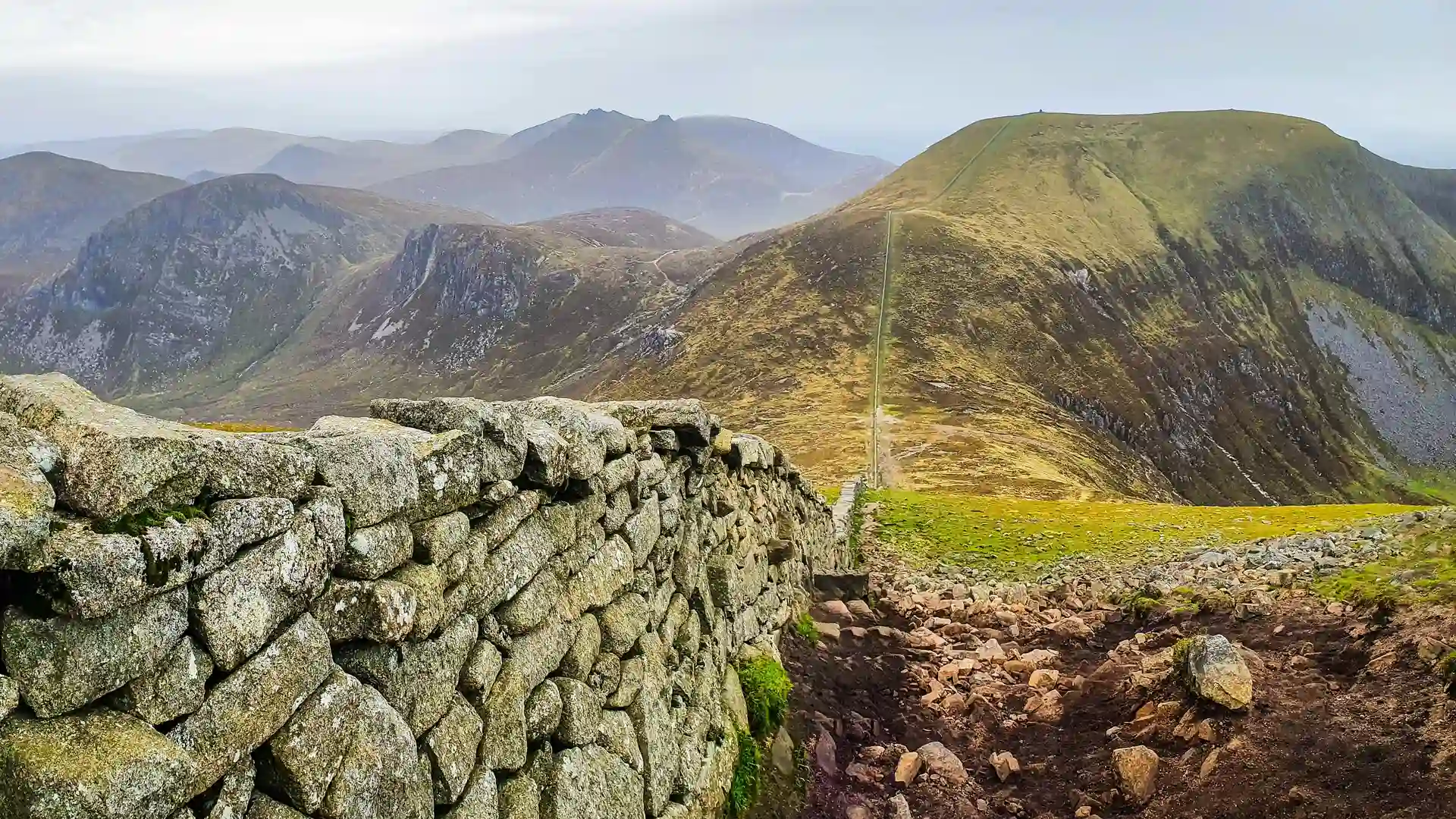
Stone ridges, enclosed valleys, and open high ground shaped by rock, water, and weather
The Mourne Mountains rise inland from the south-east coast of Northern Ireland, forming the region’s highest and most extensive upland ground. Here, self-guided travel follows walking routes across granite ridges, reservoir tracks, and open moorland between places such as Newcastle, Rostrevor, Hilltown, and the Silent Valley. Paths including the Mourne Wall and a network of forest and hillside trails link valleys, summits, and water catchments in a compact but elevated mountain area.
The terrain is steeper and more enclosed than elsewhere in Northern Ireland. Rounded granite peaks rise directly from surrounding farmland, separated by narrow glens and reservoir basins. Stone underfoot replaces pasture and field, and routes frequently climb onto exposed ridges before dropping again into sheltered valleys. Elevation changes are sustained rather than gradual, with ascent shaping most journeys.
Much of the range lies within the Mourne National Landscape, protecting upland heath, blanket bog, woodland, and managed water catchments. The reservoirs of Silent Valley and Ben Crom sit at the centre of the hills, with tracks and service roads providing level passages through otherwise rugged ground. Settlement remains concentrated around the edges of the mountains, while the interior is largely open and uninhabited.
Movement through the Mournes tends to follow ridgelines, valley floors, or the line of the Mourne Wall itself. Higher routes connect summits in sequence, while lower tracks circle reservoirs or pass through forested slopes. Distances between access points are short, but gradients and rough surfaces slow progress compared with lowland or coastal terrain.
Stone walls, gates, and reservoir dams mark regular transition points across the landscape.
Routes & Landscapes Across the Region
The Mourne Wall runs for over 20 miles across the highest ground, linking many of the principal summits and providing a continuous line to follow across the ridge tops between Silent Valley and Slieve Donard.
Around Silent Valley and Ben Crom, wide gravel tracks circle the reservoirs and connect into surrounding hillsides, creating lower-level routes beneath the peaks.
Forest paths and hillside trails above Newcastle and Rostrevor provide shorter climbs and crossings between valleys, linking coastal towns with the upland interior.
Together, these ridge, reservoir, and forest routes form a compact network that allows high-level crossings or shorter loops without long detours.
Areas of the Mourne Mountains
The coastal foothills above Newcastle, the central reservoir basin around Silent Valley and Ben Crom, and the higher western ridges near Slieve Muck and Hilltown each present distinct combinations of summit, valley, and woodland while remaining closely connected within a relatively small mountain range.
Beginning to explore the Mourne Mountains
The Mournes function as a concentrated upland landscape rather than a dispersed region. Following ridge tracks, reservoir paths, and stone walls shows how rock, water, and access routes shape movement across Northern Ireland’s highest ground.