
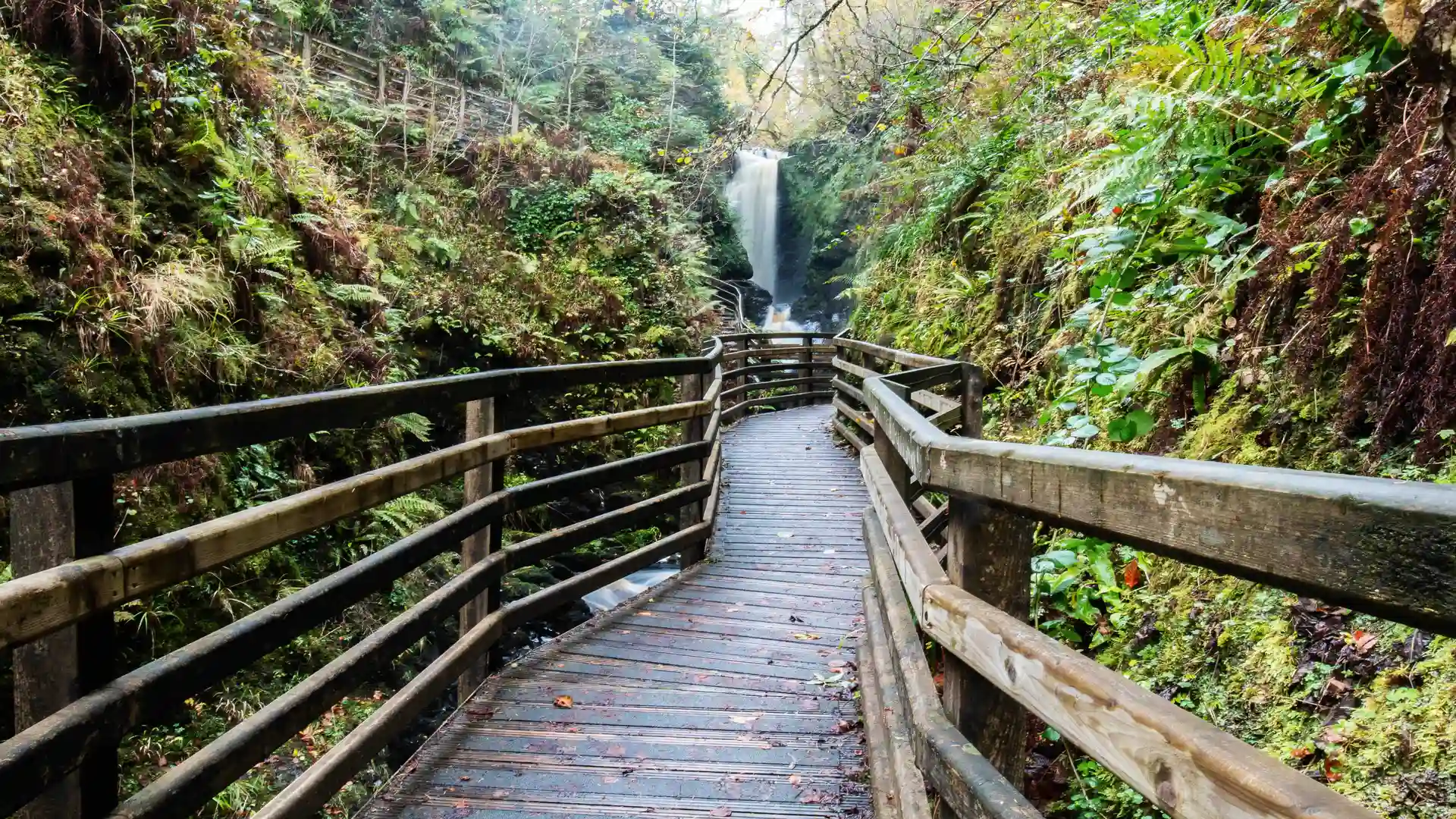
Narrow glens, pasture hills, and river corridors shaped by water, farming, and settlement
The Glens of Antrim extend south-east from the Causeway Coast toward Larne, where self-guided travel follows walking routes along short river valleys that run directly from upland to sea. Paths and minor lanes link places such as Ballycastle, Cushendall, Cushendun, Waterfoot, and Carnlough, connecting hillside pasture, woodland slopes, and small coastal villages across a series of parallel glens that open onto the North Channel.
The terrain is folded and enclosed rather than elevated. Each glen forms a narrow corridor between rounded hills, with rivers descending steadily from higher ground to the coast. Pasture and hedgerows dominate the lower slopes, while woodland and rough grassland cover steeper sides. Routes tend to follow valley floors or contour along the hillsides before descending again toward the shoreline.
Much of the area lies within the Antrim Coast and Glens National Landscape, protecting cliffs, moorland, woodland, and coastal habitats. Settlement remains closely spaced, with villages, farms, and small harbours appearing at regular intervals. Paths pass easily between open countryside and inhabited places, and few sections feel distant from services or roads.
Movement through the glens is typically short and direct. Routes run inland-to-coast along river corridors before linking sideways across the hills to neighbouring valleys. Gradients are moderate compared with the Mourne Mountains, allowing steady progress between settlements and making crossings between glens straightforward.
Stone bridges, harbour fronts, and village streets mark frequent points of transition between valley and sea.
Routes & Landscapes Across the Region
Routes through the Glens of Antrim generally follow the natural line of each valley, connecting upland slopes with coastal settlements such as Cushendall, Cushendun, and Carnlough before continuing along the shoreline toward Ballycastle or Larne.
Higher ground above the glens provides ridge and hillside tracks that link neighbouring valleys, allowing crossings between catchments without returning to the coast.
Short coastal sections connect the mouths of the glens, combining clifftop paths, beaches, and minor roads into longer shoreline stages that tie the region into the Causeway Coast to the west.
Together, these valley, ridge, and coastal links create a compact network of routes that can be combined into loops or short multi-day journeys.
Areas of the Glens of Antrim
The northern glens around Ballycastle and Cushendun, the central valleys around Cushendall and Waterfoot, and the southern stretches near Carnlough and Glenarm each present distinct combinations of woodland, pasture, and shoreline while remaining closely connected along the coast.
Beginning to explore the Glens of Antrim
The Glens of Antrim function as a series of parallel corridors between hill and sea. Following rivers inland and paths across the ridges shows how water, farming, and settlement continue to shape movement through this closely linked coastal landscape.