
Volcanic ridges, tidal shores, and green corridors shaped by water, stone, and settlement
Edinburgh & the Lothians are shaped by their walking routes, compact coastal and hill landscapes, and the neighbourhoods and towns they connect. Trails such as the John Muir Way along the Firth of Forth, the Water of Leith Walkway through the capital, and upland paths in the Pentland Hills link harbour towns, parkland, and open hillside, creating one of Scotland’s most accessible regions for steady, self-guided travel between coast, river, and city.
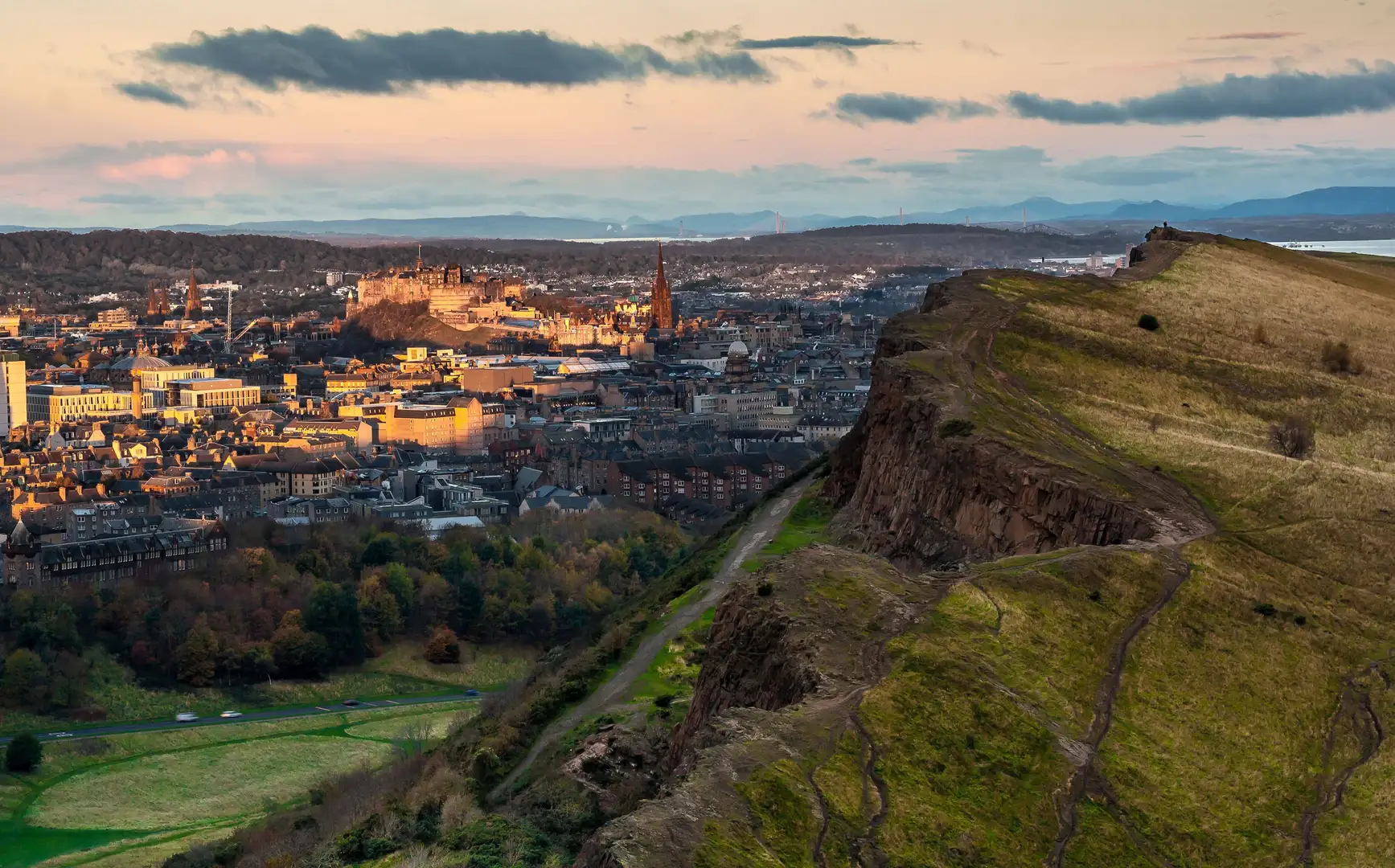
The terrain is varied but close-knit. To the east, long beaches, dunes, and rocky shelves edge the shoreline between Musselburgh, North Berwick, and Dunbar. Inland, farmland and estate woodland rise gradually towards low volcanic hills, while within the city dark crags and ridges form distinctive landmarks. Arthur’s Seat and Salisbury Crags lift directly above streets and terraces, giving short climbs with wide views across the Forth and surrounding countryside.
Water shapes many routes. The Water of Leith threads from the Pentland Hills to the sea, guiding a continuous riverside path through woodland, parks, and historic districts. Canal towpaths and former railway lines create level green corridors between suburbs and open ground, allowing movement through the region without traffic or steep gradients.
Much of the landscape is protected or publicly accessible. The Pentland Hills Regional Park safeguards heather slopes, reservoirs, and quiet upland tracks close to the city, while coastal habitats along the Forth protect dunes, saltmarsh, and seabird colonies. Parks and estates throughout the Lothians maintain a patchwork of woodland, meadow, and farmland where paths pass easily between settlement and open land.
Movement often follows long-established lines. Old drove roads, estate tracks, riverbanks, and shoreline paths continue to shape today’s trails. The John Muir Way forms a coast-to-coast route through the region, linking Dunbar with Edinburgh and onward to the west, while shorter urban and rural paths intersect frequently, making it easy to combine sections into longer days.
Walking here is defined by continuity rather than remoteness. Villages, cafés, and stations appear regularly, and coast, countryside, and city sit within easy reach of one another. Progress feels flexible and grounded, with routes shaped as much by everyday life as by distance.
This is a region best understood step by step: from harbour to hillside, along rivers and ridgelines where urban and rural landscapes meet.
Routes & Landscapes Across the Region
The John Muir Way follows the Firth of Forth between Dunbar and Edinburgh, combining beaches, cliffs, farmland, and harbour towns.
The Water of Leith Walkway provides a continuous riverside route through woodland and parkland from the Pentland Hills to Leith.
Paths in the Pentland Hills Regional Park explore rolling upland terrain, reservoirs, and open views across the Lothians.
Shorter hill routes around Arthur’s Seat and Salisbury Crags offer direct access to elevated ground beside the city centre.
Areas of Edinburgh & The Lothians
East Lothian, Midlothian, West Lothian, and Edinburgh itself each offer distinct combinations of coast, farmland, woodland, and low hills, providing natural bases for linking urban and countryside routes.
Beginning to explore Edinburgh & The Lothians
Edinburgh & the Lothians form a connected network of coastal paths, riverside walks, and upland tracks rather than a single focal landscape. Following these routes reveals how closely city life and open ground sit side by side, allowing travel that feels continuous and easy to shape.