
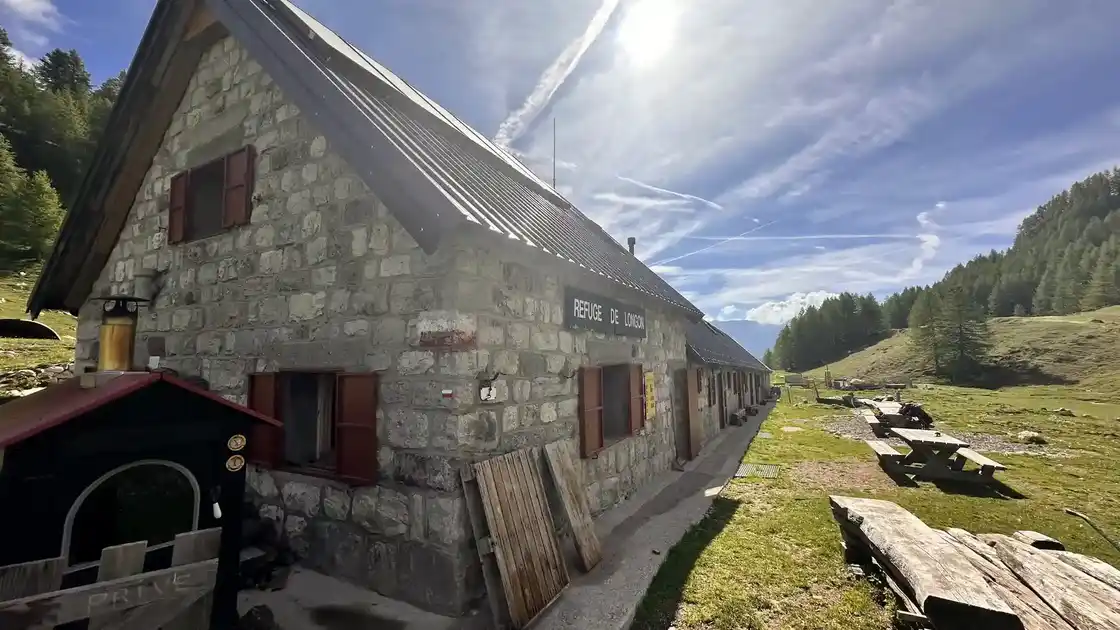
A working refuge on the GR5
The GR5 passes Refuge de Longon high above the Tinée Valley, within Mercantour National Park in the French Alps.
The refuge sits among the high pastures above Roure and serves both walkers travelling through the mountains and the farming family working there during the summer.
A former pastoral barn, the building is now a mountain refuge with accommodation, shared spaces and a working cheese dairy.
From Roure to the high pastures
During winter, the farming family lives and works around Roure, below the high pastures used during summer.
As the snow retreats, the farm moves uphill to Longon, where the animals graze during the warmer months.
The refuge lies at around 1,880 metres, with surrounding grazing extending onto higher ground. There is no road to Longon, and access is on foot from the valley below.
This seasonal movement between village and mountain pasture remains part of the farming system around the refuge.
Supplies by foot and donkey
Without road access, supplies and equipment have to reach Longon along the mountain paths.
Donkeys are used to carry produce and equipment between the valley and the refuge, travelling along the same network of paths used by walkers.
The journey connects Roure with the high pastures and provides the practical link between the farm's lower and upper locations.
A refuge for GR5 walkers
For walkers on the GR5, Refuge de Longon provides accommodation and food directly beside the route.
The refuge combines dormitories and rooms with the working spaces required by the farm and dairy.
Its location makes it both an overnight stop for long-distance walkers and part of the pastoral landscape through which the GR5 passes.
Food from the farm
Milk from the farm's animals is used to produce cheeses and other dairy products.
Production changes through the season as the animals and farming activity move between Roure and Longon. During summer, cheese is produced in the high pastures alongside the refuge.
Meals also make use of farm produce and ingredients gathered locally, including herbs and other plants found in the surrounding landscape.
The kitchen and dairy are therefore closely connected to the agricultural work taking place around the refuge.
Farming in Mercantour
Pastoral farming in Mercantour also involves managing the presence of wolves in the surrounding mountains.
Protection dogs, night enclosures, GPS tracking and the presence of shepherds are among the measures used to protect livestock.
Predation remains a practical concern for farms operating in the high pastures and forms part of the wider relationship between agriculture and wildlife within the national park.
Walking through a pastoral landscape
The landscape crossed by the GR5 through Mercantour is not separate from the farming that takes place within it.
Grazing, seasonal livestock movements, mountain paths and refuges have developed together over generations.
At Longon, walkers pass directly through this working landscape, with the refuge providing a visible connection between the long-distance trail and the agricultural use of the surrounding mountains.
Continuing along the GR5
From Refuge de Longon, the GR5 continues through the high ground of Mercantour National Park.
For walkers following the route, Longon is one of a series of mountain refuges connecting stages through the French Alps.
Its combination of refuge, farm and summer pasture gives this particular stop a character closely connected to the landscape through which the trail passes.
Stay at Refuge de Longon
Refuge de Longon provides accommodation directly on the GR5, high above the Tinée Valley in Mercantour National Park. The working mountain refuge combines simple accommodation for walkers with the seasonal farm and cheese dairy described in this article.
Featured Stay: Refuge de Longon

