

At the Pace of the Alps
Long-distance walking routes are often described in kilometres, stages, and elevation gain. But in places like the southern French Alps, the GR5 passes through something more complex than terrain alone. It crosses working landscapes — places where walking, farming, and survival are still inseparable.
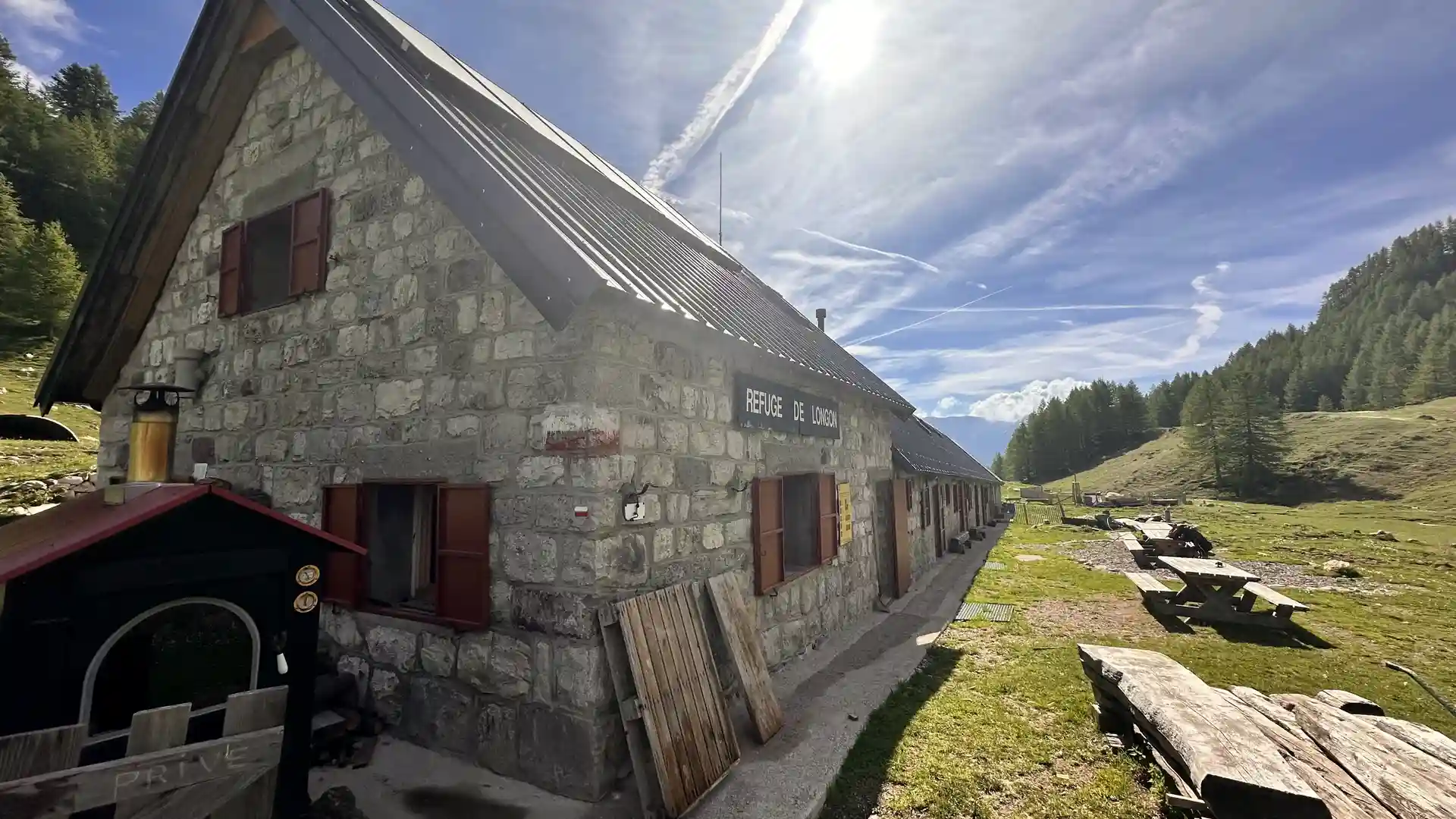
One of the clearest examples lies high above the Tinée Valley, within Mercantour National Park, where the GR5 passes Refuge de Longon — a mountain refuge that is also the seasonal heart of a working alpine farm.
Here, the trail does not simply pass through the mountains. It passes through a way of life.
Two Homes, One Farm
The story of Refuge de Longon begins well below the high pastures.
In winter, the farming family lives and works in the village of Roure, at around 800 metres above sea level. This is where animals are sheltered, milked year-round, and cheeses are produced during the colder months. It is also where the rhythms of village life continue long after the high mountains become inaccessible.
Each year, as snow retreats and summer approaches, the farm moves upward.
From June until early autumn, the family, their herds, and their work relocate to the high alpine pastures of Longon, between 2,000 and 2,200 metres. The refuge — a former pastoral barn — becomes home, dairy, kitchen, and shelter all at once.
There is no road between these two places.
The journey from Roure to Longon requires a two-hour walk with around 520 metres of ascent, starting near the Roure arboretum and climbing steadily into open mountain terrain. Everything that sustains life at the refuge must be carried — or walked — into place.
Walking With the Donkeys
Supplies do not arrive by vehicle at Refuge de Longon. They arrive by foot.
Donkeys are part of daily life here, used to transport fresh produce and equipment along the same paths walked by hikers on the GR5. Their role is practical rather than symbolic — a logistics solution adapted to steep terrain and fragile ground.
For some visitors, the journey to Longon begins in Roure alongside these animals, walking the same historic routes that have connected village and pasture for generations. Luggage travels by donkey; people travel at walking pace.
This is not a performance or a re-enactment. It is simply how the mountains still function.
Arrival at Longon
Refuge de Longon sits high above the valley floor, surrounded by open pasture, larch forest, and wide mountain basins. It exists where it does because animals graze here, and because walkers pass through here.
The building itself reflects this dual purpose. Once a pastoral shelter, it has been carefully adapted to serve both farmers and hikers — with dormitories and rooms, shared spaces, and a working cheese dairy attached to the refuge.
There is no sense of arrival in the conventional travel sense. Instead, there is a pause — a place where long-distance journeys slow, meals are shared, and the work of the mountains continues.
For walkers on the GR5, Longon is not a destination. It is a necessary and welcome waypoint.
Eating the Landscape
Meals at Refuge de Longon are shaped by what the land produces.
Milk — cow, goat, and sheep — is central, transformed daily into cheeses, curds, cream, and fermented products such as Lait de lune. Tommes made in Roure earlier in the season are joined later by Longon tomme, produced at altitude once the herds have moved uphill.
Brousse cheese is served fresh, sometimes straight from the cauldron. Meat comes from the farm’s own animals, raised across village meadows and high pastures. Foraged ingredients — nettles, wild spinach, mushrooms, thyme, linden — find their way into dishes alongside alpine staples.
Cooking happens around a wood-fired stove, guided by practicality rather than presentation. Meals are generous, shared, and shaped by availability. This is food as a continuation of farm work, not an interpretation of it.
Farming, Predation, and Reality
Life at Longon is not insulated from the realities of modern mountain farming.
Wolves have been present in the Alpes-Maritimes since the early 1990s, and predation remains a constant concern. Protection dogs, night enclosures, GPS tracking, and human presence are all part of daily routines — yet losses still occur.
When attacks happen, animals must be located, documented, and reported. Compensation processes are time-consuming, emotionally draining, and never complete. These pressures sit quietly alongside the refuge’s hospitality, rarely visible to passing walkers but ever-present in daily life.
This is an important part of the story. Refuge de Longon is not an idealised alpine scene — it is a working place shaped by responsibility, effort, and constraint.
Walking as Witness, Not Consumption
Most people who pass through Longon will do so as walkers on the GR5 — stopping for a meal, a night, or simply a rest before continuing across the high ground.
A small number choose to stay longer, joining a short, structured immersion that begins in the village and follows the same route taken by the farm each summer. Over two days, participants walk with donkeys, share meals, observe milking and cheese-making, and take part in discussions about pastoral life — from technical processes to the challenges facing modern mountain farming.
These moments are not presented as activities to be consumed. They are framed as opportunities to understand how walking routes, farming systems, and protected landscapes coexist.
Numbers are limited. Seasons are short. Availability depends entirely on weather, animals, and workload.
Why This Matters on the GR5
The GR5 is often described as a route linking seas, countries, and mountain ranges. But its continuity depends just as much on places like Longon — where paths remain open because land is still worked, and where refuges exist because farming still happens.
Walking through Mercantour National Park is not a journey through wilderness untouched by people. It is a journey through landscapes shaped by centuries of movement, grazing, and seasonal migration.
Refuge de Longon sits at the intersection of these forces — a place where the GR5 becomes more than a line on a map.
Walking On
Most walkers will leave Longon the same way they arrived: on foot, heading toward the next pass, the next valley, the next stage.
The farm will continue its seasonal rhythm long after boots have passed through — herds moving, milk being transformed, paths being used because they still matter.
On routes like the GR5, walking is not just a way of travelling through mountains. In places like this, it is part of how the mountains continue to live.