
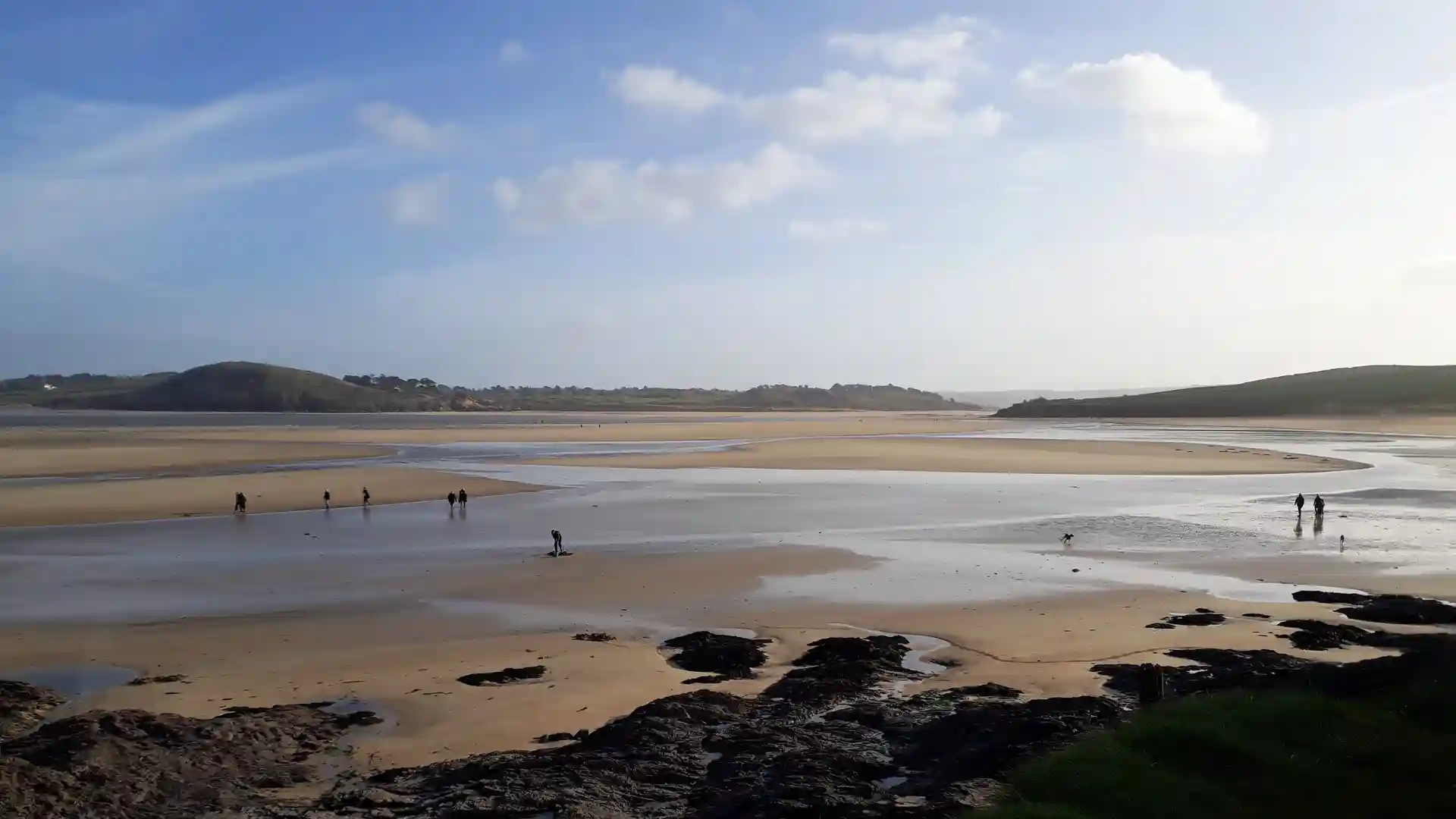

Wide sandy estuary at low tide near Padstow, Cornwall, marking the starting point of the Saints’ Way walking trail.

Saints’ Way – Walking Cornwall’s Inland Spine

Type of trail?
Pilgrimage route
Is it for me?
Moderate long-distance walk
Rolling terrain with regular climbs and descents, suited to confident long-distance walking.
What will I see?
Historic harbours and coastal towns
Rolling Countryside
Surf beaches and rocky coves
Scenic Hills
Historic & Heritage Sites
Historic towns and villages
Woodland Trails
Rivers & Streams
What’s the vibe?
Coastal heritage and culture
Adventurous and Challenging
Remote and Wild
Countryside and coast
Countryside and heritage
Historic and cultural

A historic pilgrimage trail across Cornwall

The Saints’ Way, in the South West of England (Cornish: Forth an Syns) is a 30-mile long-distance path crossing Cornwall from Padstow on the north coast to Fowey on the south coast. It follows ancient pilgrimage and trade routes once used by travellers crossing Cornwall to avoid sailing the dangerous seas around Land’s End.

Today, it’s a popular choice for shorter walking holidays and outdoor adventures, offering a mix of coastal estuaries, rolling countryside, ancient churches, and historic towns. From fishing harbours to granite tors, and from river valleys to prehistoric sites, the Saints’ Way is a trail that blends heritage with varied Cornish scenery.

Trail Overview

  • Type: Long-distance walking route (waymarked with a green Celtic cross)
  • Distance: 30 miles (48 km)
  • Start: Padstow, North Cornwall coast
  • End: Fowey, South Cornwall coast
  • Time required: 2–3 days (full route)
  • Terrain: Farmland, moorland, estuaries, rivers, historic towns and villages
  • Difficulty: Moderate — rolling countryside, some steep climbs
  • Accessibility: Good waymarking; can be split into short sections or day walks

Explore the Route

Padstow to Lanivet

From the harbour town of Padstow, the path heads inland across farmland and wooded valleys, passing Iron Age earthworks, medieval churches, and the village of Lanivet, regarded as the geographical centre of Cornwall.

Lanivet to Lostwithiel

The route continues past ancient wayside crosses and Helman Tor, a granite hill with panoramic views. Descending into the Fowey Valley, walkers reach Lostwithiel, a historic town once the capital of Cornwall.

Lostwithiel to Fowey

The final stage follows the River Fowey estuary through lush woodland and riverside paths before reaching the bustling harbour town of Fowey, famous for its maritime heritage and literary links.

Stay and Explore

  • Harbour towns: Padstow and Fowey, both full of seafood restaurants, pubs, and boutique stays
  • Historic towns: Lostwithiel, with its castle ruins and medieval character
  • Rural stays: Farm B&Bs and country inns around Lanivet and the Fowey Valley
  • Food & drink: Cornwall is famous for fresh seafood, Cornish pasties, and locally brewed ales
  • Cultural stops: Ancient churches, Celtic crosses, and Helman Tor’s prehistoric remains

Adventure Highlights

  • Starting at Padstow Harbour and finishing at Fowey Harbour
  • Pilgrimage heritage: churches, chapels, and Celtic crosses along the way
  • Scenic climb to Helman Tor, with panoramic views over mid-Cornwall
  • The medieval town of Lostwithiel
  • Estuary walking along the River Fowey
  • A true coast-to-coast trail in miniature (north to south Cornwall in 2–3 days)

Frequently Asked Questions

Where does the Saints’ Way go?

It runs from Padstow on the north Cornwall coast to Fowey on the south coast, crossing around 30 miles of countryside.

How long does it take to walk the Saints’ Way?

The full trail takes 2–3 days, though many walkers split it into shorter day stages.

Is the Saints’ Way difficult?

It is rated moderate, with rolling countryside and some steep climbs, but it is accessible for most walkers.

Why is it called the Saints’ Way?

The name comes from the pilgrims and saints who travelled this route in medieval times, crossing Cornwall on foot to avoid the dangerous seas around Land’s End.

What is the best part of the Saints’ Way?

Highlights include Helman Tor, Lostwithiel’s medieval charm, and the estuary approach into Fowey.