
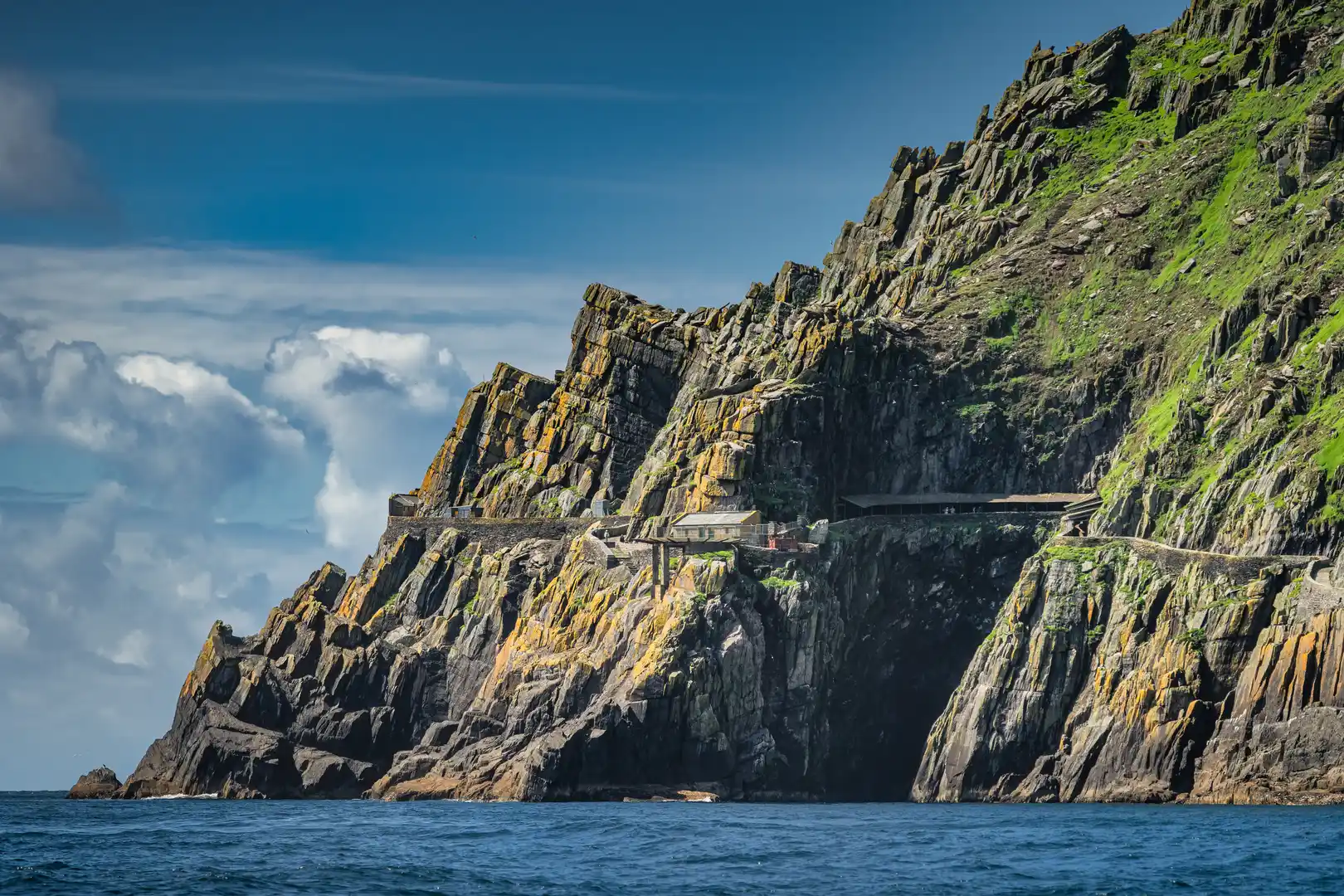
Skellig Michael UNESCO World Heritage Site – Monastic Stone, Atlantic Isolation, and Sea Cliffs
Stone Steps, Sheer Cliffs, and Open Atlantic Horizon
Skellig Michael is one of Ireland’s most remote and distinctive places for self-guided travel, shaped by walking routes, exposed rock, and historic places rising directly from the Atlantic Ocean off the coast of County Kerry. Reached by boat from the Iveragh Peninsula, the island stands alone at sea, where steep stone steps lead from the landing point to a 6th-century monastic settlement high above the water. Rather than a network of trails, walking here follows a single historic ascent, linking sea level with terraces, oratories, and viewpoints across the surrounding ocean.
The island’s terrain is abrupt and elemental. Sharp ridges, narrow paths, and vertical cliffs define the landscape, while seabirds circle overhead and waves break far below. Every movement is shaped by exposure and weather, with wind and salt air reinforcing the sense of distance from the mainland.
Despite its small size, Skellig Michael feels expansive and quiet. Climbing slowly reveals changing perspectives of Little Skellig and the Kerry coast, and the monastery emerges gradually from the rock as a cluster of stone beehive huts. Walking here feels both physical and contemplative, where isolation and history are inseparable from the landscape itself.
About the UNESCO World Heritage Site
Skellig Michael was inscribed as a UNESCO World Heritage Site in 1996 for its outstanding cultural and archaeological significance. The island preserves one of the most remarkable early Christian monastic settlements in Europe, established by monks seeking solitude and spiritual retreat between the 6th and 12th centuries.
Stone steps, terraces, huts, and small oratories were constructed directly into the steep rock, forming a settlement that has survived largely unchanged for centuries. The combination of dramatic natural setting and fragile historic remains gives the island exceptional value as both a cultural and natural landscape.
Today, carefully managed access helps protect the site while allowing visitors to experience it on foot.
Where to Walk
Monastic Stairway Ascent
A steep climb of more than 600 historic stone steps from the landing point to the monastery terraces, rising around 180 metres above sea level.
Summit Terraces & Monastery Paths
Short paths around the beehive huts, oratories, and viewpoints at the top of the island.
South Peak Viewpoints (seasonal access)
Rugged, exposed routes toward the higher ridges, offering wide Atlantic views and a stronger sense of isolation.
Highlights
- A 6th-century monastic settlement perched above the Atlantic
- More than 600 hand-carved stone steps forming the main ascent
- Sheer cliffs and uninterrupted ocean views in all directions
- Large seabird colonies including puffins and gannets
- A rare sense of remoteness and quiet
- One of Ireland’s most dramatic UNESCO-listed landscapes