
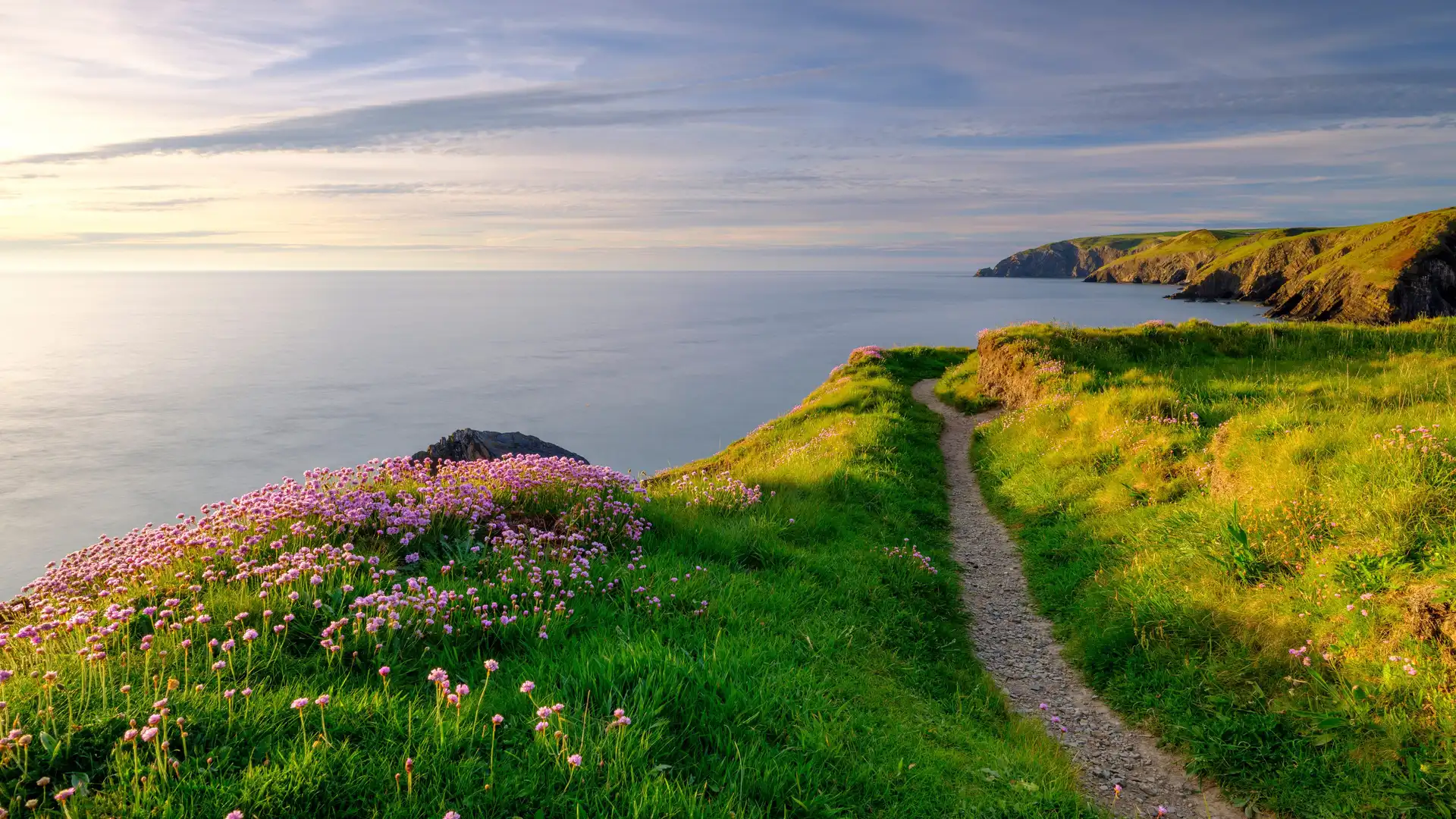
West Wales – Sea Cliffs, Estuaries, and Upland Hills
Coastline, river valleys, and exposed high ground shaped by water, stone, and weather
West Wales sits at the far western edge of Britain, where walking routes follow cliff tops, estuary shores, and inland hills between places such as St Davids, Fishguard, Cardigan, and Newcastle Emlyn. Trails including the Pembrokeshire Coast Path, upland tracks across the Preseli Hills, and riverside paths along the Teifi link protected coastline with quiet valleys and small settlements, creating long, continuous journeys across coast, river, and open ground.
The land meets the sea abruptly here. Headlands rise straight from the water, broken by narrow coves, beaches, and small harbours. The coastline feels exposed and tidal, with constant changes in light and weather. Inland, the terrain softens into rounded hills, pasture, and woodland valleys where rivers cut slower, more sheltered routes through the landscape.
Much of the coast falls within the Pembrokeshire Coast National Park, protecting cliffs, heath, and offshore islands rich in birdlife. Away from the sea, the Preseli Hills form a broad upland plateau of moor and rough grassland, while the Teifi Valley creates a lower, greener corridor of farmland and ancient woodland. These protected and semi-wild landscapes sit alongside working farms and small towns, and paths pass easily between them.
Movement through West Wales tends to follow natural lines. Coastal trails contour the cliff edge, rising and falling with every headland. Inland routes follow riverbanks, old drovers’ roads, and minor lanes between settlements. The result is walking that feels continuous rather than fragmented — long stretches shaped more by distance and exposure than by steep ascent.
This is a region of space and edge: long horizons, wide skies, and settlements that appear gradually after miles of open ground.
Routes & Landscapes Across the Region
The Pembrokeshire Coast Path traces the full length of the shoreline between Amroth and St Dogmaels, rising and falling with each headland as it links beaches, coves, small harbours, and cliff-top farmland along one of Britain’s most exposed stretches of coast.
Inland, the Preseli Hills provide higher, open ground, where moorland tracks and old drovers’ routes cross rounded ridges scattered with standing stones and prehistoric sites, creating longer crossings between the coast and the Teifi Valley.
Following the river west to east, paths along the Teifi connect Cardigan, Llandysul, Lampeter, and Newcastle Emlyn through woodland, meadow, and farmland, offering gentler, lower-level walking that contrasts with the exposed coastline and upland interior.
Together, these coastal, upland, and riverside routes form a loose network that allows movement between sea, hill, and valley without returning to the same ground, shaping West Wales as a region best travelled in long, continuous stages rather than short, isolated walks.+
Areas of West Wales
Pembrokeshire, Ceredigion, and western Carmarthenshire each offer distinct variations of the same structure — exposed coast, sheltered valley, and upland interior — providing natural bases for linking shoreline and inland routes within a single journey.
Beginning to explore West Wales
West Wales forms a connected network of coastal and inland paths rather than a single focal destination. Following its cliff edges, river valleys, and hill tracks gradually reveals how sea, stone, and settlement continue to guide movement through this quieter part of Wales.
Frequently Asked Questions
What terrain should I expect?
Clifftop paths, rolling hills, and river valleys. Coastal sections are uneven and undulating, while inland routes are generally gentler.
Are there longer routes?
Yes. The Pembrokeshire Coast Path provides an extended coastal journey, and inland valley and upland paths can be linked for multi-day crossings.
Are there protected landscapes?
Yes. The Pembrokeshire Coast National Park covers much of the coastline, with additional upland and river landscapes inland.
Is the region remote?
Some coastal and upland sections feel isolated, though towns and villages appear regularly along the main routes.
Can routes be combined easily?
Yes. Coastal and inland paths intersect at several towns, allowing journeys to move between shore, hill, and valley.