
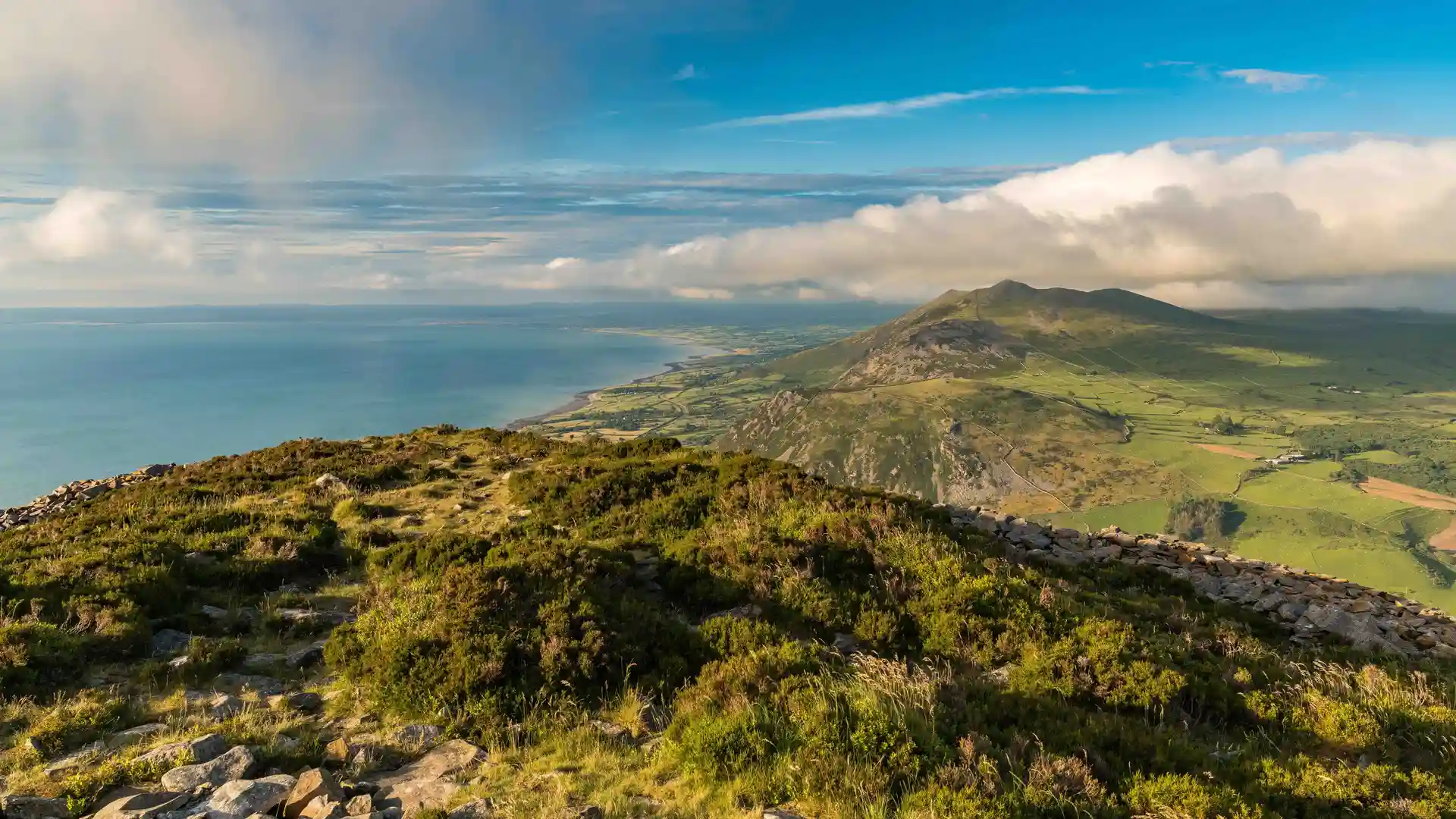
North Wales – Mountains, Coast, and Ancient Paths
Rocky summits, tidal shores, and long-established routes shaped by stone, sea, and language
North Wales is shaped by its walking routes, mountainous terrain, and the coastal and rural communities they connect. Trails climb through Eryri National Park, follow the shoreline of the Wales Coast Path, and cross border hills along Offa’s Dyke Path, linking places such as Conwy, Betws-y-Coed, Llangollen, and the Llŷn Peninsula. The result is a region where movement shifts quickly between high ground, river valley, and sea.
The geography is bold and immediate. Mountain ridges rise directly from glacial lakes and steep-sided valleys, while to the north and west the land falls away into beaches, cliffs, and broad tidal estuaries. Peaks such as Yr Wyddfa (Snowdon) and the Carneddau dominate the skyline, yet only a few miles away paths follow farmland lanes and sheltered woodland beside the River Dee. Routes often feel compressed into short distances, allowing dramatic changes in landscape within a single day.
Much of the region is protected. Eryri National Park safeguards extensive mountain, moor, woodland, and lake landscapes at the heart of North Wales, while long stretches of coast and headland are designated for their wildlife and geological value. These protected areas maintain both habitat and working rural life, with paths passing easily between upland pasture, stone-walled fields, and small harbour settlements.
Movement through North Wales frequently follows historic lines. Drovers’ roads, quarry tracks, and pilgrimage routes still guide today’s trails across passes and along valleys. The North Wales Path crosses the foothills east to west between market towns and hill country, while the Wales Coast Path traces continuous shoreline from estuary to headland. Inland, canal and riverside paths near Llangollen provide level alternatives through settled countryside.
Walking here is shaped by contrast. Steeper mountain sections alternate with level coastal or valley stretches, and villages appear regularly between open ground. Progress can feel demanding in the uplands yet calm and steady beside river or sea, giving the region a varied but connected rhythm.
This is a region best understood step by step: across rocky ridges, beside still lakes, and along tidal edges where mountain and coastline sit side by side.
Routes & Landscapes Across the Region
The Eryri National Park contains a dense network of mountain and valley paths, including routes around Yr Wyddfa, the Ogwen Valley, and quieter ground in the Rhinogydd and Carneddau.
The Wales Coast Path follows beaches, dunes, and headlands around Anglesey and the Llŷn Peninsula, linking fishing villages and broad bays.
The North Wales Path crosses the foothills between Prestatyn and Machynlleth through hill country, woodland, and farmland.
Sections of Offa’s Dyke Path follow the English–Welsh border south from Llangollen along ridgelines with wide views across the Dee Valley.
Areas of North Wales
Eryri, the Llŷn Peninsula, Anglesey, the Conwy Valley, and the Dee Valley each offer distinct combinations of mountain, coast, woodland, and farmland, providing natural bases for linking inland and shoreline routes.
Beginning to explore North Wales
North Wales forms a connected network of upland trails, coastal paths, and valley routes rather than a single focal landscape. Following these lines reveals how closely mountain, river, and sea relate to one another, with journeys shaped by terrain and settlement rather than distance alone.
Frequently Asked Questions
What defines walking in North Wales?
Mountain paths, coastal trails, valley tracks, and historic routes linking towns and villages.
Are there long-distance routes in the region?
Yes. The Wales Coast Path, North Wales Path, and Offa’s Dyke Path all cross the area.
Is the terrain challenging?
Upland sections can be steep and rocky, while coastal and valley routes are generally gentler.
Are there protected landscapes?
Yes. Much of the region lies within Eryri National Park, alongside protected coastal habitats.
Can routes be combined easily?
Yes. Trails intersect frequently and many towns provide natural starting and finishing points.